
- Thread starter
- #1
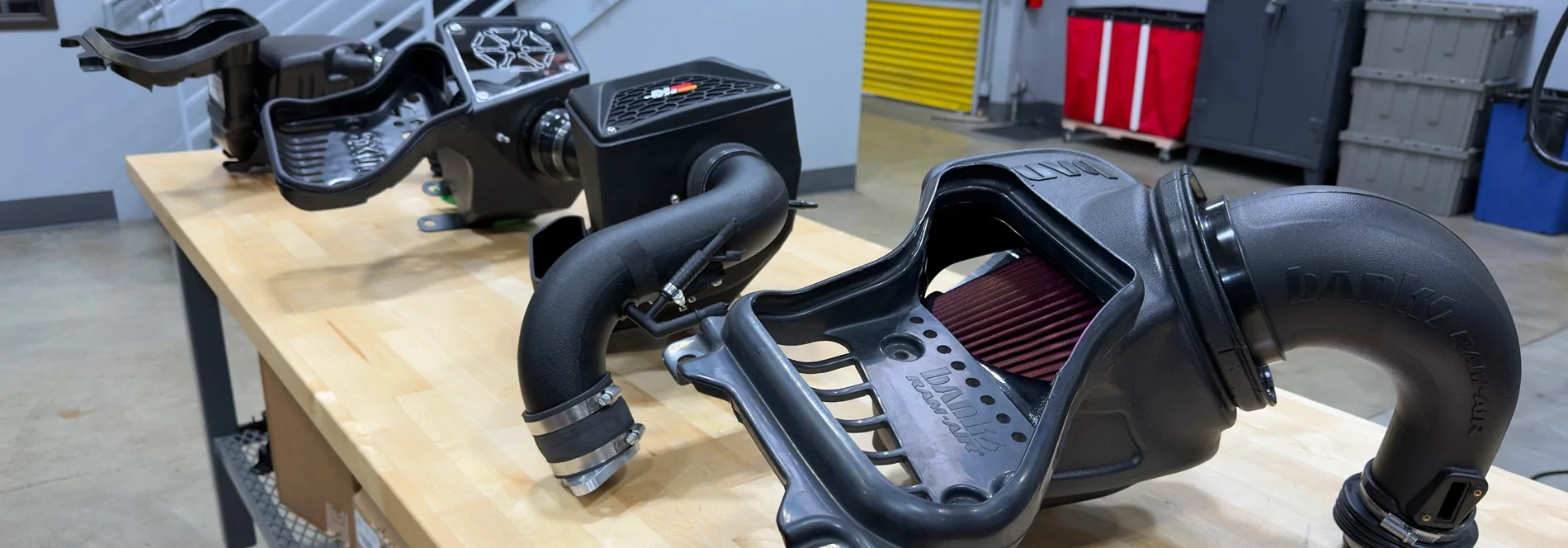
Which Cold Air Intake Is Best for the 2024–2026 Toyota Tacoma?
Four intake systems. Mass airflow testing. Chassis dyno testing. Compressor temperatures, boost pressure, and independent horsepower results.
In the latest episode of Banks Speed School, Gale Banks compares the factory intake against Banks Ram-Air, SXTH Element, and K&N. Rather than relying solely on horsepower claims, Gale measures filter sizes, inlet dimensions, airflow restriction, compressor temperatures, turbocharger boost pressure, and wheel horsepower.
The results reveal significant engineering differences. And for those questioning Banks' horsepower claims, an independent dyno test from AVA Dynamics provides additional evidence.
The Horsepower Results: Banks Comes Out on Top
Banks tested all four intakes on a non-hybrid 2024 Tacoma TRD Off-Road using a Mustang chassis dynamometer.
Unlike a traditional acceleration sweep, Banks used a 35-second lug-down test simulating a Tacoma climbing a steep hill at wide-open throttle while engine RPM decreases under load.
Three tests were performed with each intake. Before every run, Banks controlled and monitored environmental conditions, coolant temperature, compressor inlet temperature, catalytic-converter inlet temperature, and other parameters.
Wheel Horsepower Comparison
| Intake | Wheel HP | Gain vs. Stock |
|---|---|---|
| Toyota factory | 256.0 | — |
| K&N | 252.0 | -4.0 |
| SXTH Element | 268.9 | +12.9 |
| Banks Ram-Air | 279.2 | +23.2 |
Banks gained 23.2 wheel horsepower over stock, outperforming SXTH by 10.3 horsepower. Surprisingly, K&N actually lost four horsepower.
But not everyone has reported these results.
What About CAM Tuning's Independent Test?
Some SXTH supporters have pointed to a third-party test published by CAM Tuning on Tacoma4G, showing Banks and SXTH producing virtually identical horsepower.
CAM tested all four intakes on the same truck using a Dynojet chassis dynamometer.
CAM Tuning Results
| Intake | Wheel HP | Gain vs. Stock |
|---|---|---|
| Toyota factory | 234.93 | — |
| K&N | 243.86 | +8.93 |
| SXTH Element | 244.58 | +9.65 |
| Banks Ram-Air | 244.98 | +10.05 |
These results are legitimate measurements under CAM's test conditions. However, they don't establish the maximum horsepower each intake is capable of producing.
Here's why.
Toyota's Factory Power Limiters Can Influence Dyno Results
The Tacoma's ECU protects the engine and emissions system by monitoring critical operating parameters, including catalytic-converter temperature.
When the ECU determines that catalyst protection is necessary, it can intervene and reduce engine output.
Banks carefully controls starting conditions, including catalytic-converter inlet temperature, allowing the truck to cool between tests to ensure consistency.
An engine operating under protective power limits may not reveal the full advantage of a less restrictive intake.
And another independent dyno test demonstrates just how much more power the Banks intake can produce.
AVA Dynamics Independently Confirms a 20.7 HP Gain
On February 17, 2026, AVA Dynamics LLC independently tested the Banks Ram-Air Intake against the stock Toyota system using a Dynojet chassis dynamometer.
The results:
| Configuration | Wheel HP |
|---|---|
| Stock intake | 183.52 |
| Banks Ram-Air | 204.20 |
| Horsepower gain | +20.68 |
AVA independently recorded a 20.7-wheel-horsepower improvement with Banks, nearly double the gain measured by CAM Tuning.
Banks Horsepower Gains Across Three Tests
| Testing Organization | Gain vs. Stock |
|---|---|
| CAM Tuning | +10.05 whp |
| AVA Dynamics | +20.68 whp |
| Gale Banks Engineering | +23.2 whp |
Different trucks, dynos, and testing procedures can produce different absolute horsepower figures. That's why comparing gains against stock within each individual test is essential.
AVA's results don't invalidate CAM's findings. They establish that CAM's 10-horsepower gain is not the performance ceiling of the Banks Ram-Air Intake.
And while AVA didn't test SXTH, its independent findings closely support the gains measured by Banks.
For anyone demanding third-party confirmation of Banks' horsepower improvements, this test provides it.
The Mass Airflow Bench Reveals Why Banks Makes More Power
Horsepower is the result. Airflow and pressure loss help explain how you get there.
Before dyno testing, Gale measured the physical dimensions of each intake system.
Intake Dimensions
| Measurement | K&N | SXTH | Banks |
|---|---|---|---|
| Inlet throat | 10.60 sq. in. | 14.27 | 22.47 |
| Filter surface area | 625 sq. in. | 462 | 866 |
| Filter outlet | 5.73 sq. in. | 7.07 | 17.35 |
Banks has the largest inlet, filter, and filter outlet.
Its filter has 87% more surface area than SXTH's, providing greater potential dirt-loading capacity before restriction increases.
But how do these dimensions affect performance?
Mass Airflow at 10 Inches of Water Pressure Loss
| Intake | Airflow (lb/min) | Gain vs. Stock |
|---|---|---|
| Toyota factory | 22.1 | — |
| K&N | 25.4 | +14.8% |
| SXTH Element | 26.8 | +21.1% |
| Banks Ram-Air | 30.4 | +37.5% |
At equal pressure loss, Banks moved more air than the competition.
More importantly, Banks measured how much pressure each intake lost while supplying the engine's peak airflow demand of 30.4 pounds per minute.
Pressure Loss at Peak Engine Airflow
| Intake | Pressure Loss (in. H₂O) | Reduction vs. Stock |
|---|---|---|
| Toyota factory | 18.5 | — |
| K&N | 14.2 | 23.2% |
| SXTH Element | 12.7 | 31.4% |
| Banks Ram-Air | 10.0 | 45.9% |
Banks reduces intake restriction by approximately 46% compared with stock and 21% compared with SXTH.
On a turbocharged engine, this matters because pressure lost before the compressor increases the work required to produce the desired boost.
These physical measurements demonstrate advantages that may not be fully reflected in every dyno test.
Why K&N Lost Horsepower Despite Better Airflow
One of the most revealing discoveries was K&N's performance.
Although K&N flowed 14.8% more air than stock on the bench, it produced four fewer horsepower on the dyno.
Gale's temperature measurements help explain why.
Compressor Inlet Temperature Rise During Testing
| Intake | Temperature Increase |
|---|---|
| Banks Ram-Air | +0.8°F |
| Toyota factory | +1.6°F |
| SXTH Element | +7.8°F |
| K&N | +31.0°F |
During the 35-second test, K&N's compressor inlet temperature increased by 31°F, indicating substantial exposure to underhood heat.
SXTH also experienced elevated inlet temperatures. Banks delivered air at essentially ambient temperature.
The turbocharger boost measurements reinforced the differences.
| Intake | Compressor Discharge Pressure |
|---|---|
| K&N | 16.2 psi |
| Toyota factory | 16.6 psi |
| SXTH Element | 17.7 psi |
| Banks Ram-Air | 18.6 psi |
Banks delivered the coolest compressor inlet air and the highest measured compressor discharge pressure.
The lesson? A cold air intake must do more than flow air. It must deliver cool, dense air with minimal pressure loss.
What About SXTH and K&N's Advertised Horsepower Gains?
SXTH Element advertises gains of up to 14 wheel horsepower and 14 lb-ft of torque. In Banks' testing, SXTH gained 12.9 horsepower, reasonably close to that claim.
However, SXTH's intake exhibited greater pressure loss, higher compressor inlet temperatures, and lower horsepower than Banks in Gale's tests.
K&N advertises an estimated horsepower increase of 15.6 hp. Its published graphic includes this disclaimer:
"Estimated performance gains based on specific or similar dynamometer and airflow tests. Results may vary."
Estimated performance figures are not necessarily representative of what a particular Tacoma will produce under a given set of operating conditions.
In Banks' testing, K&N's intake actually reduced horsepower, and its elevated compressor inlet temperatures help explain the result.
One More Advantage: 50-State Emissions Compliance
There's another significant difference between these intake systems that won't appear on a dyno chart.
The Banks Ram-Air Intake is CARB compliant under Executive Order D-161-182 for 2024–2026 Tacoma and 2025-2026 4Runners
That means it's emissions legal for use in all 50 states on the covered vehicles.
Neither the SXTH Element nor K&N intake in this comparison has the corresponding CARB exemption for these Tacoma applications.
Achieving CARB compliance requires extensive engineering, development, and emissions validation to ensure a performance product doesn't compromise the vehicle's emissions systems.
The Bottom Line: One Dyno Test Doesn't Tell the Whole Story
CAM Tuning's independent test showed nearly identical horsepower gains from Banks and SXTH. But that result alone doesn't establish that the two intakes perform equally under all operating conditions.
AVA Dynamics independently measured a 20.7-wheel-horsepower gain with Banks, closely supporting Banks' own 23.2-horsepower result.
Meanwhile, Gale's engineering analysis demonstrated that Banks has:
- The largest cold air inlet, filter surface area, and filter outlet.
- Approximately 46% less pressure loss than stock.
- The lowest measured compressor inlet temperature rise.
- The highest measured compressor discharge pressure.
- The greatest horsepower gain in Banks' controlled comparison.
- CARB emissions compliance for all 50 states on covered applications.
Banks Ram-Air Intake systems are available for 2024–2026 Toyota Tacoma and 6th Generation Toyota 4Runner gas and hybrids. TRD Pro and Trailhunter models are coming soon.
Sponsored
Last edited: