
Sponsored

5w-30

IDontWorkForTheWaterCo

SR
Active member
Joined
Jul 11, 2026
Threads
2
Messages
32
Reaction score
37
Location
USA
Vehicle(s)
2026 Tacoma SR
On the Banks iDash. I also have temp sensors going to my MT and Rear Diff fill plugs.

Regarding weights being weights and they're all the same, this is unconfirmed and not published, but ratings were posted on the forums, a reply from Valovline support regarding their HTHS values.
https://bobistheoilguy.com/forums/t...d-protect-hths.399575/?utm_source=chatgpt.com

Letting ChatGPT do some of the research for me (this is a snippet)

So if those Restore & Protect numbers are real, the practical interpretation would be:

Restore & Protect 0W-20 at 2.65 cP
This would be a fairly fuel-economy-leaning 20-grade. It would still meet the SAE 20 hot-shear floor, but it would sit close to the minimum, suggesting Valvoline optimized it more toward low drag / efficiency / cold-flow friendliness than toward maximum hot-shear thickness. That does not mean it is “bad” or unsafe if your engine is designed for it; modern OEMs often specify oils in this range intentionally.


Restore & Protect 5W-20 at 3.17 cP
This would be a much stouter oil under load than most people expect from a 20-grade. A 3.17 cP HTHS sits well above the SAE 20 minimum and even overlaps the broader low-HS/low-SAPS European fuel-economy territory where minimum HTHS is often 2.9 or higher, depending on spec. In practice, that would usually mean thicker oil film under hot load, potentially a little more margin for wear control, noise damping, and oil consumption resistance, at the possible expense of a bit of fuel economy.
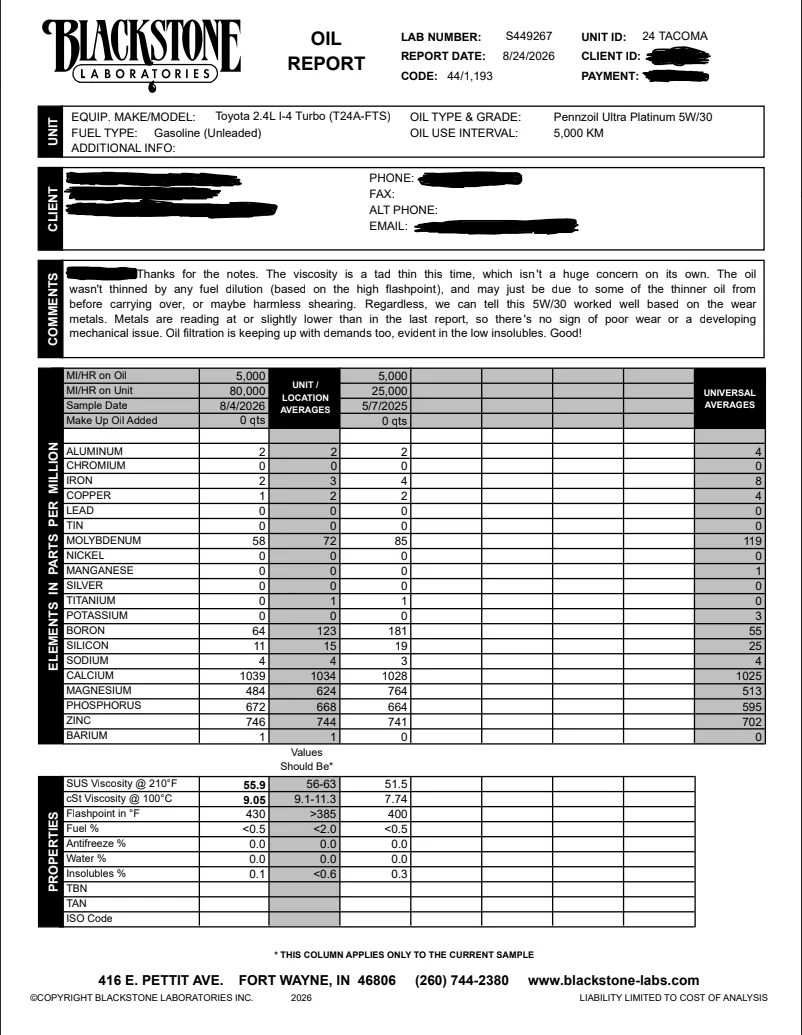
Oh definitely. There are "light" and "heavy" KV100 scores on all grades. I just meant from a practical stand point, it would tough to measure a big difference in performance between a 0w20 and a 5w20 given that they will both perform as 20's at operating temperature.

An argument could be made that on average a 5w20 could potentially be slightly more sheer stable than a 0w20 do to less friction modifiers.....assuming the 5w20 is a synthetic.
Sponsored

 
Last edited:

Andrace

TRD Off-Road Premium
Well-known member
Joined
Mar 17, 2025
Threads
3
Messages
174
Reaction score
105
Location
California
Vehicle(s)
2024 TRD Off-Road 6MT
What actually matters is the temp of the oil at the rings, in the bearings, and in the turbo, which is different from where it's measured at the sensor. Speed Jr mentions this in a video, some capillary tubing used to sample oil from the rings. will try to find that.
 

Andrace

TRD Off-Road Premium
Well-known member
Joined
Mar 17, 2025
Threads
3
Messages
174
Reaction score
105
Location
California
Vehicle(s)
2024 TRD Off-Road 6MT
[QUOTE="IDontWorkForTheWaterCo, post: 271117, member: 10817"
Could be an argument to be made that on average a 5w20 could potentially be slightly more sheer stable than a 0w20 do to less friction modifiers.....assuming the 5w20 is a synthetic.
[/QUOTE]

That's the primary reason I opted to go with 5-20, it's more shear stable and offers more headroom in conditions when it really matters.
 

IDontWorkForTheWaterCo

SR
Active member
Joined
Jul 11, 2026
Threads
2
Messages
32
Reaction score
37
Location
USA
Vehicle(s)
2026 Tacoma SR
What actually matters is the temp of the oil at the rings, in the bearings, and in the turbo, which is different from where it's measured at the sensor. Speed Jr mentions this in a video, some capillary tubing used to sample oil from the rings. will try to find that.
Temp is very important. Back in 2017, when Toyota introduced the first Dynamic Force engine (A25A) lots of people freaked out when they saw the 0w16 recommendation. But fast forward nearly a decade, and you have Camrys and RAV4s running around with 200k on them. 0w16 is a thin oil. But when your running oil temps of 170° to 190° that 0w16 stays "thick" at operating temperature.

But I'm not a thick vs thin kind of guy. I say run whatever viscosity that makes you comfortable.
Sponsored


Top