
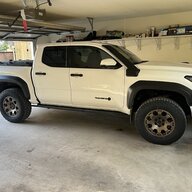

YeahHis trans was the issue, right?
I have that fear for my truck too.
Sponsored
YeahHis trans was the issue, right?
I have that fear for my truck too.

Yes!What I did on my old truck when it developed a vibration was I downloaded a free vibration recorder on my phone. Then I drove the truck at the speed it was most pronounced (in my case, 105km/h). I compared the frequency of the vibration to the various rotating parts on the truck. In my case, the frequency of the vibration aligned with the rotational speed of the driveshaft. Basically, you can determine: Is the vibration before or after the differential? And is the vibration before or after the transmission? That helped narrow it down. In my case, it was clear that my driveshaft was unbalanced.

Did Toyota rebalance it? Or get you a new one?What I did on my old truck when it developed a vibration was I downloaded a free vibration recorder on my phone. Then I drove the truck at the speed it was most pronounced (in my case, 105km/h). I compared the frequency of the vibration to the various rotating parts on the truck. In my case, the frequency of the vibration aligned with the rotational speed of the driveshaft. Basically, you can determine: Is the vibration before or after the differential? And is the vibration before or after the transmission? That helped narrow it down. In my case, it was clear that my driveshaft was unbalanced.
That was on my Avalanche. It was old and I didn't use it a lot, so I just put up with it lol.Did Toyota rebalance it? Or get you a new one?
Can you consistently create this condition? Like it will happen every time you are coasting at 30-35? If you can re-create it easily, ask the service advisor at your dealer to send a tech with you as a passenger so you can demonstrate it. The original tech that test drove it probably didn't experience the condition you're describing.I calculated the wheel/axle and driveshaft rotational frequencies at certain wheel speeds. Then I did a bunch of vibration data logging with the "Resonance" app on my way home from work.
There was zero correlation between frequency and wheel speed, driveshaft speed, or even engine speed. The amplitude (intensity) of the vibrations were still worse in the 30-35ish mph range.
I'm honestly more confused now, and leaning towards transmission issues.
Yeah, the first Tech was patronizing and immediately dismissive when he drove it with me.Can you consistently create this condition? Like it will happen every time you are coasting at 30-35? If you can re-create it easily, ask the service advisor at your dealer to send a tech with you as a passenger so you can demonstrate it. The original tech that test drove it probably didn't experience the condition you're describing.
Definitely not normal. Is there another dealership nearby?Update: so far, the dealership is saying that this is "normal" for Tacomas and they can't do anything about it. It really feels like a transmission shudder, and is the worst between 30-40mph at light to no throttle.
I have a case open with Corporate Toyota, and I'm calling them in a bit. We'll see what they have to say.Definitely not normal. Is there another dealership nearby?
I agree that these engines can have a "chugging" feel at very low RPMs. I noticed it on my truck too, and switching to 92 octane helped.I’d like to throw my 2 cents in here, although it may be a long shot. I’ve noticed a vibration/rumble in the engine at low speed, low rpm, and low load. It’s my understanding that 4-cylinder engines do have a little gap in power between one cylinder firing and the next, something you won’t feel with a V6. It goes away, in my case, if you manually change to a lower gear and bump up the rpm but otherwise maintain speed.
While you’re probably experiencing something else, I get the sense this is where some of the low speed vibration complaints come from.
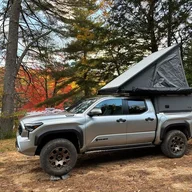
I've got a '25 Trailhunter with the 5ft bed and I'm experiencing a subtle vibration between about 15-40 MPH. I've got about 6,700 miles on the truck and don't recall feeling it until the last 1,000 miles or so. My memory tells me this truck drove incredibly smooth when it was new, and I traded a '24 Land Cruiser in for it so was already familiar with this hybrid powertrain. At about 3,000 miles I put a Super Pacific X1 camper on the truck, it weighs about 350#, and the truck still drove nicely. My wife and 20 year old son both told me separately that the Trailhunter has been making them feel nauseous lately when they drive it because of the subtle shake/ vibration. I took it to the dealer, went for a ride with the service advisor, he said he felt it but he's new at the dealership, so maybe he was just agreeing with me to be nice. I told them I was up for paying for a tire balance and alignment if they felt it would solve it. They recommended I pay $100 for a master technician to diagnose it, I agreed, and then they called me back and said they spoke to Toyota and they won't continue to diagnose it until I remove the Super Pacific from the bed. I asked for more details and they aren't willing to share any. It seemed Toyota had some areas to investigate, but the dealership refuses to provide any more details other than saying to bring it back with an empty bed. They didn't charge me anything, I took the truck home and I'm taking a pause to decide what to do next. This truck has an open recall on it for what I think is the front driveshaft, but Toyota has no timing yet on when parts will be available. I don't want to be without the camper for long so I might wait until more is known on the recall so I'm not taking the topper off and on. It will be a major pain to do that, I was hoping the topper would go on once and stay on forever. Sorry for the long post here, but I feel your pain on dealing with Toyota on this.I agree that these engines can have a "chugging" feel at very low RPMs. I noticed it on my truck too, and switching to 92 octane helped.
My issue persists even when the truck is coasting downhill, and I shift the trans into neutral. I think that eliminates the engine as a cause (in this particular case).