

- Thread starter
- #1
Banks 26012 boost tubes: where I started the airflow build
I want a full airflow build on this truck eventually, intake, intercooler, exhaust, the whole path. Before I bought any of it, I kept landing on the same thought: the air has to physically cross the engine bay before it reaches any of that, and the factory charge pipes are where that path starts. So I started there. This is part 1 of 4, and I am running the truck on a dyno before and after every stage so we can all see what the full airflow build is worth, and what each piece adds on its own. That is data nobody publishes.
Kit is the Banks 26012, on my 2024 i-FORCE MAX Trailhunter. SDHQ Off-Road did the install, about an hour, no tune.

Quick charge-pipe primer
The turbo pushes hot, pressurized air out, and the charge pipes carry it across the bay to the intercooler, then back to the throttle body. A hot side from the turbo to the intercooler, a cold side from the intercooler to the throttle body. Every bend and every coupler on that path can add restriction or leak a little pressure, so the pipes either protect boost, temperature, and a clean seal, or they give them up.
What the factory runs, and where it gives
Stock, these are rubber tubes with aluminum end caps. Toyota did that for cost and for NVH, and the rubber flexes to absorb engine movement. The tradeoff is geometry and longevity: the tubes bend hard to pack into a tight bay, and rubber softens at the bend with years of heat cycling. None of that is a day-one problem, it is the kind of thing that shows up well down the road.
What the Banks kit is
The part I actually care about: the clamp
Banks built its name in diesel performance, where street trucks run far more boost than ours ever see, and the standard practice there is constant-tension T-bolt clamps. A constant-tension clamp holds its grip as the joint expands and contracts through heat cycles. A worm-drive clamp does not, it backs off over time. That clamp load is also high enough to bite into a soft aluminum bead and work it loose over the years, where 409 stainless holds its shape. That clamp-interface durability is the real reason to care about stainless here, not charge-air cooling. The air spends too little time in a few feet of pipe for the wall material to move intake temps much, your intercooler sets that.
Couplers and adapters
The couplers add a Nomex inner layer, the same fiber used in firefighter gear and race suits, which raises the temperature ceiling and resists abrasion at the clamp. That fifth ply is burst margin over a typical 3 or 4 ply. At stock boost a good 4-ply is already inside its rating, so this is headroom, not a cure for a problem anyone is having. The billet quick-connects are machined with smooth internal transitions so there is no step at the junction.
The 3-inch thing, straight
Banks runs uniform 3 inch on both sides. The stepped kits drop the hot side to 2.5 inch, and that is the textbook dimension: a smaller hot side keeps charge velocity up and gives the turbo less volume to fill, which spools quicker on a stock truck. So the 3 inch hot pipe is the bigger number, not automatically the better one, until the turbo flows enough air to use it. The uniform 3 inch is build-readiness for where this is going, not a stock-truck flow gain.
Compliance, and a fair word on SXTH
The couplers have a real job beyond carrying boost: the engine moves on its mounts, the intercooler is bolted to the chassis, and the couplers across that gap absorb the difference. Longer coupler, more travel, and Banks runs them long at every connection. SXTH is the closest design match, same uniform 3 inch, and to be fair their coupler lengths match Banks at three of the four connections. They differ at the turbo outlet, where SXTH runs a straight coupler with the bend in the tube and a hump they tested for flex. Banks runs a longer coupler there. Both are deliberate calls.
Where it sits in the field
Straight talk on power and the knocks
I am not going to tell you a charge pipe makes power on a stock truck. It does not, and Banks publishes no dyno for this part. The honest knocks: no published dyno for the 26012, no listed wall thickness, and at ~$498 it sits mid-field on price, so the materials case has to be worth it to you. For me the stainless, the CARB EO, and the fact that I am building the whole airflow path made it the right place to start.

Foundation is in. Intake is next, dyno before and after.
Anyone else start at the pipes instead of the intake? Curious where people land on order of operations.
Full> writeup on the blog
IG: @portal.hunter>
I want a full airflow build on this truck eventually, intake, intercooler, exhaust, the whole path. Before I bought any of it, I kept landing on the same thought: the air has to physically cross the engine bay before it reaches any of that, and the factory charge pipes are where that path starts. So I started there. This is part 1 of 4, and I am running the truck on a dyno before and after every stage so we can all see what the full airflow build is worth, and what each piece adds on its own. That is data nobody publishes.
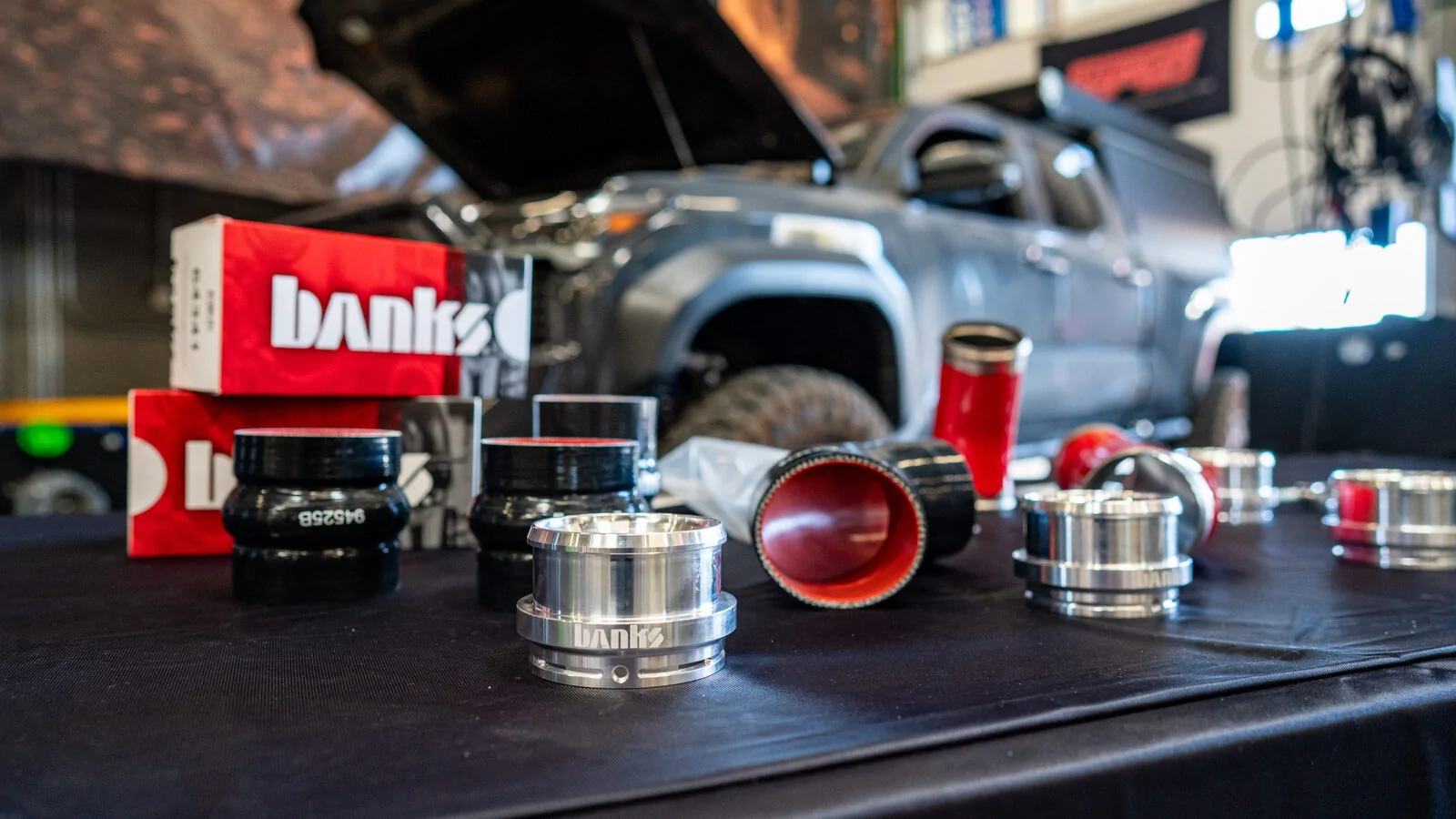
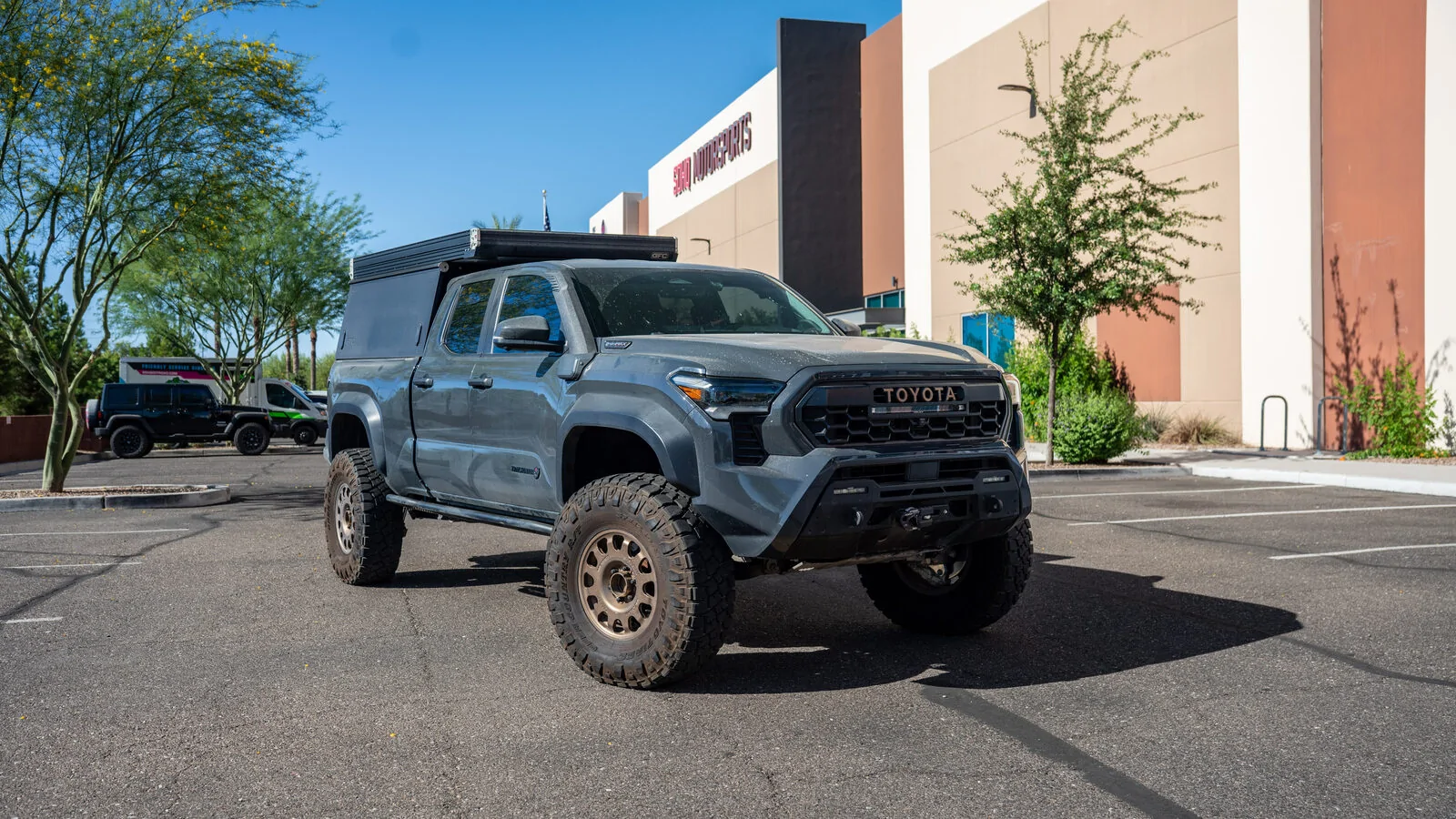
Kit is the Banks 26012, on my 2024 i-FORCE MAX Trailhunter. SDHQ Off-Road did the install, about an hour, no tune.
Quick charge-pipe primer
The turbo pushes hot, pressurized air out, and the charge pipes carry it across the bay to the intercooler, then back to the throttle body. A hot side from the turbo to the intercooler, a cold side from the intercooler to the throttle body. Every bend and every coupler on that path can add restriction or leak a little pressure, so the pipes either protect boost, temperature, and a clean seal, or they give them up.
What the factory runs, and where it gives
Stock, these are rubber tubes with aluminum end caps. Toyota did that for cost and for NVH, and the rubber flexes to absorb engine movement. The tradeoff is geometry and longevity: the tubes bend hard to pack into a tight bay, and rubber softens at the bend with years of heat cycling. None of that is a day-one problem, it is the kind of thing that shows up well down the road.
What the Banks kit is
- 409 stainless tubing, mandrel bent, uniform 3 inch on both sides
- 5-ply Nomex-infused silicone couplers
- Billet aluminum quick-connect adapters that mate to the OEM fittings with no mods
- No tune, nothing to undo at inspection
- Fits 2024-2026 Tacoma, 4Runner, Land Cruiser, gas and i-FORCE MAX
The part I actually care about: the clamp
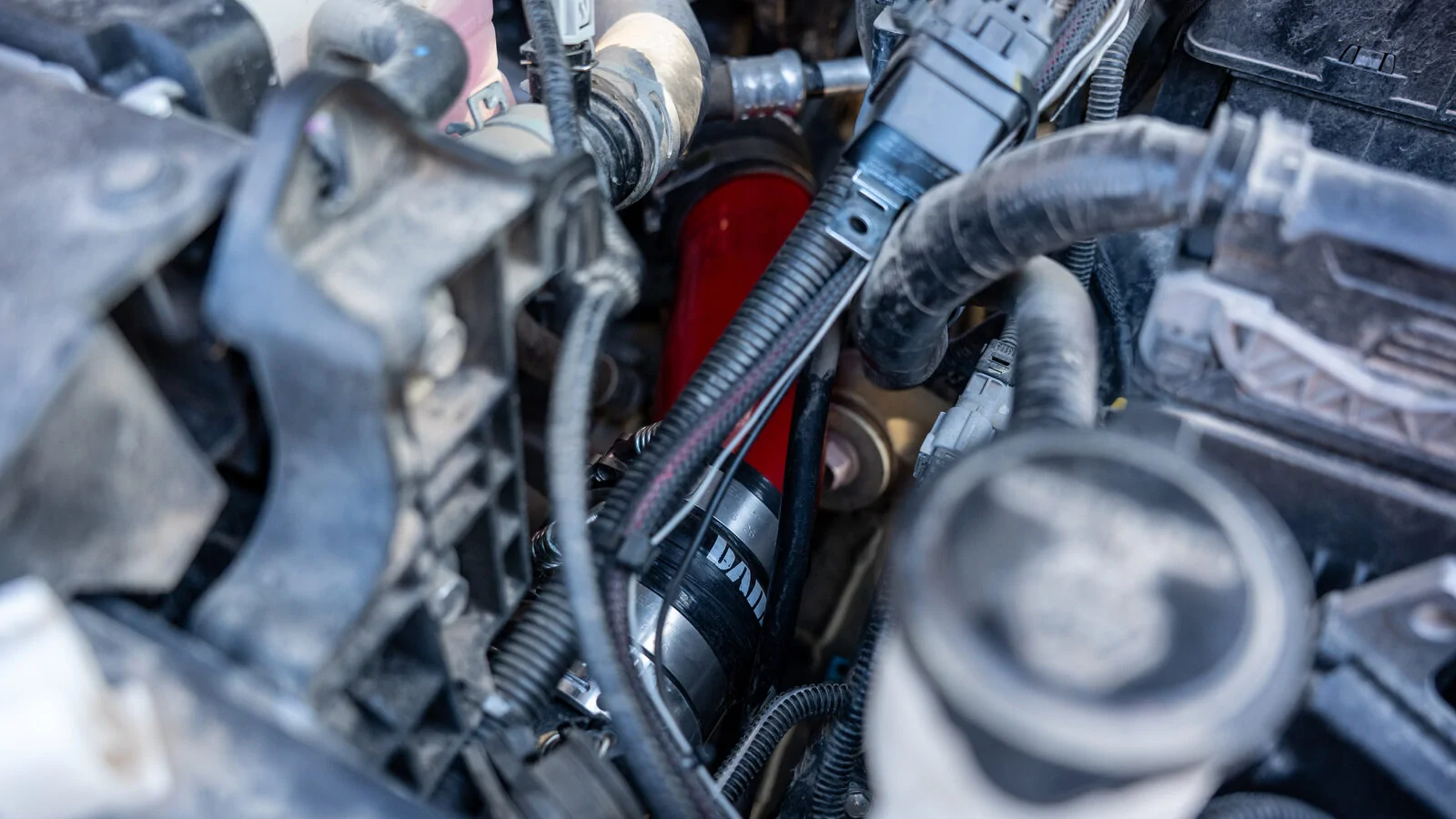
Banks built its name in diesel performance, where street trucks run far more boost than ours ever see, and the standard practice there is constant-tension T-bolt clamps. A constant-tension clamp holds its grip as the joint expands and contracts through heat cycles. A worm-drive clamp does not, it backs off over time. That clamp load is also high enough to bite into a soft aluminum bead and work it loose over the years, where 409 stainless holds its shape. That clamp-interface durability is the real reason to care about stainless here, not charge-air cooling. The air spends too little time in a few feet of pipe for the wall material to move intake temps much, your intercooler sets that.
Couplers and adapters
The couplers add a Nomex inner layer, the same fiber used in firefighter gear and race suits, which raises the temperature ceiling and resists abrasion at the clamp. That fifth ply is burst margin over a typical 3 or 4 ply. At stock boost a good 4-ply is already inside its rating, so this is headroom, not a cure for a problem anyone is having. The billet quick-connects are machined with smooth internal transitions so there is no step at the junction.
The 3-inch thing, straight
Banks runs uniform 3 inch on both sides. The stepped kits drop the hot side to 2.5 inch, and that is the textbook dimension: a smaller hot side keeps charge velocity up and gives the turbo less volume to fill, which spools quicker on a stock truck. So the 3 inch hot pipe is the bigger number, not automatically the better one, until the turbo flows enough air to use it. The uniform 3 inch is build-readiness for where this is going, not a stock-truck flow gain.
Compliance, and a fair word on SXTH
The couplers have a real job beyond carrying boost: the engine moves on its mounts, the intercooler is bolted to the chassis, and the couplers across that gap absorb the difference. Longer coupler, more travel, and Banks runs them long at every connection. SXTH is the closest design match, same uniform 3 inch, and to be fair their coupler lengths match Banks at three of the four connections. They differ at the turbo outlet, where SXTH runs a straight coupler with the bend in the tube and a hump they tested for flex. Banks runs a longer coupler there. Both are deliberate calls.
Where it sits in the field
- Banks: 409 stainless, uniform 3 inch, the only stainless kit and the only CARB-legal one, ~$498
- SXTH: aluminum, uniform 3 inch, flow-first, ~$399
- aFe: aluminum, 2.5/3 stepped, publishes a dyno at +10 hp / +11 lb-ft, ~$572
- Mishimoto: aluminum, 2.5/3 stepped, lifetime warranty, ~$447
- K&N: aluminum, guaranteed +4.5 hp / +5.2 lb-ft, ~$630
Straight talk on power and the knocks
I am not going to tell you a charge pipe makes power on a stock truck. It does not, and Banks publishes no dyno for this part. The honest knocks: no published dyno for the 26012, no listed wall thickness, and at ~$498 it sits mid-field on price, so the materials case has to be worth it to you. For me the stainless, the CARB EO, and the fact that I am building the whole airflow path made it the right place to start.

Foundation is in. Intake is next, dyno before and after.
Anyone else start at the pipes instead of the intake? Curious where people land on order of operations.
Full> writeup on the blog
IG: @portal.hunter>
Sponsored