Sponsored

JayTech

TRD Off-Road Premium
Well-known member
First Name
Jay
Joined
May 5, 2025
Threads
2
Messages
169
Reaction score
162
Location
Canada
Vehicle(s)
2025 Toyota Tacoma TRD ORP
Session 5:
Shift Schedules: RPM vs Output Shaft Speed (And Why Your Truck Feels the Way It Does)
If you’ve ever thought “this truck should’ve shifted already” or “why did it short-shift there?” — this post is for you.
Most people assume automatic transmissions shift purely based on engine RPM.
In reality, modern Toyota transmissions care much more about Output Shaft Speed (OSS).
What’s the difference?
  • Engine RPM tells you how fast the engine is spinning.
  • Output Shaft Speed tells the transmission how fast the vehicle is actually moving through the gears.
OSS accounts for:
  • Gear ratio
  • Torque converter behavior
  • Tire size
  • Load
  • Throttle input
That makes it a far more reliable signal for deciding when to shift.
Why this matters for drivability
Because shift schedules are often based on OSS:
  • Two pulls to the same RPM can shift at different road speeds
  • The truck may hold a gear longer under load, even at the same RPM
  • Light throttle can cause earlier, smoother shifts
  • Heavy throttle can delay shifts without increasing RPM targets
This is why changing engine power alone doesn’t always change how the truck feels to drive.
What tuning can (and can’t) influence
A refined calibration aligns:
  • Torque delivery
  • Throttle behavior
  • Shift timing
When these agree with the OSS-based strategy, the result is:
  • Fewer “busy” shifts
  • More predictable downshifts
  • Better part-throttle smoothness
  • A transmission that feels like it’s anticipating your intent
Discussion encouraged:
Have you noticed situations where the truck feels like it “should’ve shifted” but didn’t—or shifted when you didn’t expect it to?
One thing I have seen a few people mention is how the transmission "feels like a cvt" when it shifts under throttle and holds a specific RPM range when I would imagine that is just the transmission trying to stay within the torque curve for optimal acceleration. Or are there other factors at play?
Sponsored

 
OP
OP
CAMTuning

CAMTuning

TRD Off-Road
Well-known member
BASIC Sponsor
First Name
Cameron
Joined
Apr 2, 2025
Threads
14
Messages
232
Reaction score
295
Location
New Mexico
Vehicle(s)
2025 Tacoma TRD OffRoad
One thing I have seen a few people mention is how the transmission "feels like a cvt" when it shifts under throttle and holds a specific RPM range when I would imagine that is just the transmission trying to stay within the torque curve for optimal acceleration. Or are there other factors at play?
I have noticed the same on my truck when it had the OEM calibration. I offer a few variations of TCM mapping, and have my customers try a couple if they want to experience the difference.

The shift schedule is indexed by accelerator pedal position (driver demand) vs. output shaft speed(which can be translated to vehicle speed). That’s why it can feel like it’s “holding” a band — it’s following a driver-demand based map, not reacting to RPM alone.

Up shift and downshift have their own schedules, per gear, and per drive mode.
Normal vs Sport changes which set of maps/strategies it’s using (and how aggressive it is about holding gears and commanding downshifts), so the same pedal input at the same speed can result in a different gear choice.
 
OP
OP
CAMTuning

CAMTuning

TRD Off-Road
Well-known member
BASIC Sponsor
First Name
Cameron
Joined
Apr 2, 2025
Threads
14
Messages
232
Reaction score
295
Location
New Mexico
Vehicle(s)
2025 Tacoma TRD OffRoad
Session 6: Rotating Weight: Why Bigger Tires Feel Like Lost Power (and How Tuning Gets It Back)

Let’s take a quick break from sensors, trims, and tables and talk about something you can feel immediately behind the wheel: rotating weight.

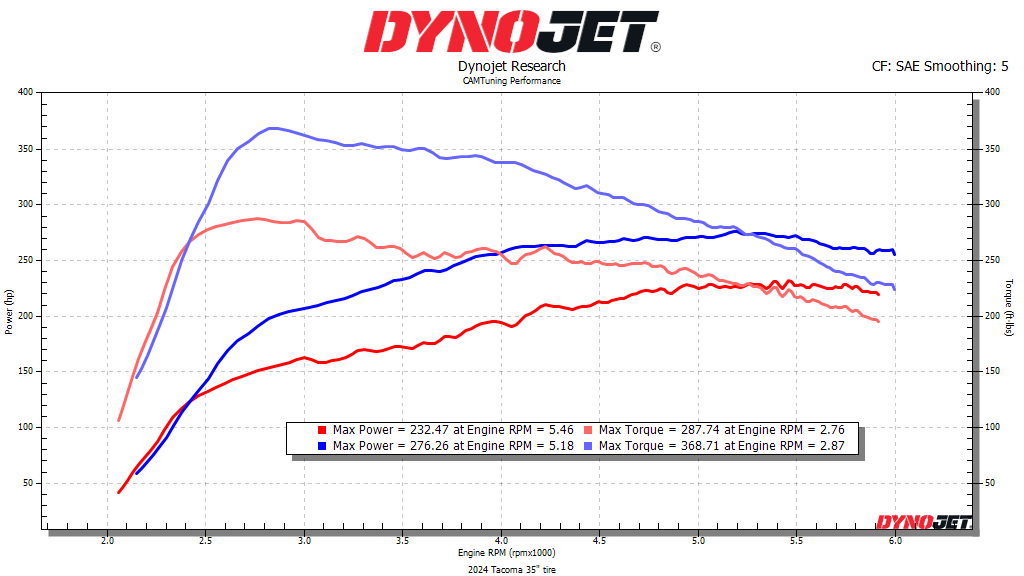
Earlier this week I had a Tacoma on the dyno running significantly heavier tire and wheel combo than stock. No engine changes. Same truck. Same dyno. The only variable was rotating mass.
(These tires are ~65lbs each, on factory wheels)
The baseline result was exactly what you’d expect:
  • Lower measured power
  • Slower acceleration
  • A drivetrain that had to work harder to do the same job
But here’s the part most people miss.

That “lost power” isn’t gone — it’s being used.

Why rotating weight matters more than vehicle weight

Rotating mass (tires, wheels, driveshafts) doesn’t just need to be moved forward — it has to be spun. That means:
  • More torque required to accelerate
  • More load on the engine and transmission
  • Slower rate of RPM change
  • Heavier demand during shifts

This is why trucks often feel:
  • Sluggish after tire upgrades
  • Lazy to downshift
  • Less responsive at part throttle
What the dyno showed

Despite the heavier setup, once calibrated correctly:
  • Torque gains were equal to—or better than—stock-tire trucks
  • Throttle response improved noticeably
  • The power curve became smoother and more usable
2024 Tacoma Tuning Facts - Understand Your Truck Like We Do at CAMTuning 2024 non  hybrid tacoma 35i


The tune didn’t “add magic horsepower.”
It reclaimed efficiency that the stock calibration wasn’t designed to preserve with heavier rotating mass.


OEM calibrations are built for factory tires.
Once you change that equation, the strategy needs to change too.

The takeaway

Big tires don’t ruin performance — unaddressed calibration does.

When torque delivery, throttle behavior, and shift strategy are aligned for the added rotating mass, the truck stops feeling heavy and starts feeling intentional again.
 
Last edited:
OP
OP
CAMTuning

CAMTuning

TRD Off-Road
Well-known member
BASIC Sponsor
First Name
Cameron
Joined
Apr 2, 2025
Threads
14
Messages
232
Reaction score
295
Location
New Mexico
Vehicle(s)
2025 Tacoma TRD OffRoad
Day late this time around. Just spent the last several days with the Cobb crew at the King of the Hammers. I've never been to that event but it's something you have to experience to understand!
Easy reading this week!

Session 7: Throttle ≠ Power


Not every throttle input needs full power. A lot of what people describe as “lag” or “soft response” is really just factory pedal mapping trying to cover every possible driver and condition.


A proper ECU calibration focuses on making small pedal inputs smooth and predictable. That’s what keeps the truck from feeling jumpy around town or hard to modulate off-road. The goal isn’t to make the truck aggressive—it’s to make it easy to drive.


This is also where ECU tuning differs from pedal-commander–type devices. Those only change how quickly the throttle opens for a given pedal input. They can make the truck feel more responsive, but they don’t change torque management, cam timing, fueling, or how the engine and transmission actually work together.


With real tuning, pedal mapping is just one part of a bigger picture. When everything is aligned, you end up with more usable power, not just sharper tip-in.


That’s the difference between a truck that feels quick when you touch the pedal and one that feels right everywhere.
 
OP
OP
CAMTuning

CAMTuning

TRD Off-Road
Well-known member
BASIC Sponsor
First Name
Cameron
Joined
Apr 2, 2025
Threads
14
Messages
232
Reaction score
295
Location
New Mexico
Vehicle(s)
2025 Tacoma TRD OffRoad
Session 8: Pulling these concepts together, and what to monitor on your Cobb Accessport

If you’re running a tuned 4th Gen Tacoma / T24 truck, your dash should give you context, not anxiety. Here’s the clean setup I recommend:


1. KCLV (Knock Correction Learn Value)
This is your long-term knock learning value.

It shows how the ECU is adapting over time based on fuel quality and operating conditions.

You’re not chasing a perfect number — you’re watching for stability.
If it lives in a consistent range and behaves predictably, that’s healthy.

Sudden sustained changes are what matter.

2. Knock Correction Angle
This is real-time knock response.

You will see small corrections. That’s normal closed-loop strategy.

Important reminder that:
-3° = effectively 0.
Seeing -3 doesn’t mean you’re “losing 3 degrees.” It’s essentially baseline behavior.

What you’re watching for isn’t small blips — it’s repeated, large corrections under steady load.

Trends > single events.

3. Boost
Keep it simple. Just boost.

Know what your truck normally makes in:
  • 3rd gear
  • 4th gear
  • Typical temps
Toyota torque targeting means boost isn’t just a “max PSI” number — it changes based on load and conditions.

If you know what’s normal for your truck, you’ll instantly spot when something is off.

4. Charge Air Temp (Post-Intercooler)
Not generic intake temp — charge temp.

This is the temperature of the air the engine is actually ingesting after compression and intercooling.

This directly affects:
  • Ignition timing
  • Knock sensitivity
  • Torque consistency
If charge temps climb, the truck may feel softer — even if nothing is wrong mechanically.

5. Long Term Fuel Trim
This is one of the most underrated parameters.

Stable trims = sealed system, healthy airflow modeling.
Sudden swing = possible boost leak, vacuum issue, or MAF contamination.

It’s an early warning system.

What I don’t recommend:

  • Staring at AFR constantly
  • Chasing peak boost numbers
  • Turning the Accessport into a stress device
The goal isn’t constant monitoring.
It’s knowing what’s normal.
Once you understand your truck’s patterns, you’ll recognize changes early.

What are you running on your dash?
 

Sponsored

Will721

TRD Off-Road
Well-known member
First Name
Will
Joined
Nov 19, 2025
Threads
0
Messages
202
Reaction score
176
Location
Quad Cities
Vehicle(s)
2025 TRD OR
Random shower thought I had the other day, I've been told these trucks run dual injection. A hybrid so to speak of manifold and direct injection. My understanding is the only pro of direct injection is better (slightly) fuel atomization which in gas engines is primarily for emissions unlike diesels.

That said, a common complaint about these trucks is the noise from the direct injection. It's so prominent that even automotive review publications have noted it. Personally, I haven't really pushed my truck hard yet as I'm still in my first oil change cycle. Meaning I haven't really noticed the direct injection "rattle" outside of initial warm up. So the question I have is, do the mpfi injectors have enough flow to support the engines by themselves and could the direct injection cycle be disabled? Are there set parameters which trigger direct injection outside of warm up? If there is a need would it be possible to disable it only at initial start up?
 
OP
OP
CAMTuning

CAMTuning

TRD Off-Road
Well-known member
BASIC Sponsor
First Name
Cameron
Joined
Apr 2, 2025
Threads
14
Messages
232
Reaction score
295
Location
New Mexico
Vehicle(s)
2025 Tacoma TRD OffRoad
Random shower thought I had the other day, I've been told these trucks run dual injection. A hybrid so to speak of manifold and direct injection. My understanding is the only pro of direct injection is better (slightly) fuel atomization which in gas engines is primarily for emissions unlike diesels.

That said, a common complaint about these trucks is the noise from the direct injection. It's so prominent that even automotive review publications have noted it. Personally, I haven't really pushed my truck hard yet as I'm still in my first oil change cycle. Meaning I haven't really noticed the direct injection "rattle" outside of initial warm up. So the question I have is, do the mpfi injectors have enough flow to support the engines by themselves and could the direct injection cycle be disabled? Are there set parameters which trigger direct injection outside of warm up? If there is a need would it be possible to disable it only at initial start up?
Yes, these are dual injection (DI + port).
One thing to clear up first: direct injection isn’t just there for emissions. On a turbo engine especially, it’s a performance advantage.

DI helps with knock resistance because of the charge cooling effect — when fuel is injected directly into the cylinder, it cools the intake charge as it evaporates. That effectively increases octane under load. It also allows more precise fuel delivery at high cylinder pressures and helps improve low-RPM torque and combustion stability.

And keep in mind, this engine is 11:1 compression from the factory. That’s relatively high for a turbocharged engine. The cooling effect from DI is a big part of how Toyota can safely run that compression ratio with boost on pump fuel without constantly riding the knock sensors. It’s not just an emissions strategy — it’s one of the reasons the engine works as well as it does.

Could the engine run on port injection alone? At very light load, probably. But under boost and higher torque demand, DI is doing important work. Removing it would effectively lower knock resistance under load, which would mean less timing, potentially less boost, and ultimately less efficiency and power.
 
OP
OP
CAMTuning

CAMTuning

TRD Off-Road
Well-known member
BASIC Sponsor
First Name
Cameron
Joined
Apr 2, 2025
Threads
14
Messages
232
Reaction score
295
Location
New Mexico
Vehicle(s)
2025 Tacoma TRD OffRoad
Session 9: Bigger Tires & Why Your MPG Display Is Lying to You

We’ve already talked about how larger tires affect acceleration and effective torque at the wheels.

Today let’s talk about something less dramatic — but just as misunderstood:

Why your displayed fuel economy often drops after installing bigger tires… even when real efficiency hasn’t changed as much as you think.

The Simple Physics

Your speedometer and odometer are calibrated for a specific tire circumference.

When you increase tire size:
  • Each rotation of the tire covers more ground
  • The truck is traveling farther per revolution
  • But the ECU still thinks you’re on stock diameter
That means:
  • Your actual speed is higher than displayed
  • Your actual distance traveled is greater than recorded
And fuel economy is calculated using:

Distance ÷ Fuel Used

If distance is being under-reported…
your MPG display will also be under-reported.

Example (simplified numbers)

Let’s say:
  • Stock tire = 31.5"
  • New tire = 33.5"
That’s roughly a ~6% increase in circumference.

If your truck says:
  • 18.0 MPG displayed
Your real MPG could be closer to:
  • ~19.0 MPG actual
Not magic. Not a tune.
Just math.

What Actually Does Hurt MPG With Bigger Tires

Now — that doesn’t mean there’s no efficiency impact.

Larger tires also:
  • Increase rotating mass
  • Increase rolling resistance
  • Change effective gearing
  • Require more torque to accelerate
So yes, some MPG loss is real.

But very often the dash number makes it look worse than it actually is.

The Takeaway

If you’ve added larger tires and your MPG “fell off a cliff,” check:
  1. Tire diameter difference
  2. Speed correction percentage
  3. Hand-calculated fuel economy
You may find the truck isn’t as inefficient as the display suggests.

Until there is a good way to calibrate the speedometer to compensate for tire size or re-gearing, this will be something that owners will have to deal with.
 
OP
OP
CAMTuning

CAMTuning

TRD Off-Road
Well-known member
BASIC Sponsor
First Name
Cameron
Joined
Apr 2, 2025
Threads
14
Messages
232
Reaction score
295
Location
New Mexico
Vehicle(s)
2025 Tacoma TRD OffRoad
Session 10: Intake temperature and how it affects power output

As temperatures climb in the spring and summer, it’s normal to notice a small reduction in engine performance. This isn’t a tuning issue — it’s physics.

Warmer air is less dense than cold air, which means each intake stroke contains less oxygen. Since power production depends on how much oxygen the engine can burn with fuel, the ECU adjusts load targets and ignition timing to keep the engine operating safely.

On turbocharged engines, the turbocharger can help compensate by increasing boost, but only within its efficiency limits. Higher intake air temperatures also increase knock sensitivity, so the ECU may reduce ignition timing slightly, which further reduces power.

Another factor is heat soak. After repeated pulls, long climbs, or even sitting in traffic, the intercooler and intake system absorb heat from the engine bay and surrounding air. Once that happens, intake temperatures rise faster and take longer to recover, which can make the vehicle feel a little softer until everything cools back down.

This is also why the same truck that feels incredibly strong on a 40°F morning might feel a bit different on a 95°F afternoon, even though nothing has changed mechanically.

Higher-power vehicles tend to make this more noticeable simply because the absolute power change is larger. A small percentage loss on a mild engine may be hard to feel, but on a high-output setup it can be very obvious.

Upgraded intercoolers are often misunderstood here. They typically don’t add peak horsepower on a single pull, but they can help maintain consistent performance by reducing heat soak and keeping intake temperatures more stable during repeated pulls or hot weather driving.
 

Sponsored

OP
OP
CAMTuning

CAMTuning

TRD Off-Road
Well-known member
BASIC Sponsor
First Name
Cameron
Joined
Apr 2, 2025
Threads
14
Messages
232
Reaction score
295
Location
New Mexico
Vehicle(s)
2025 Tacoma TRD OffRoad
Session 11: Why Two Tuned Trucks Can Feel Completely Different

One thing people often don’t realize is that two trucks with the same hardware and the same peak power can feel very different to drive.

A big part of that comes down to how the ECU interprets driver input and manages the transmission.

Modern Toyota ECUs use driver demand tables that translate pedal position into a torque request. The ECU then decides how to deliver that torque using throttle angle, boost, ignition timing, cam timing, and gear selection.

There isn’t just one “correct” way to shape that response.

Some drivers prefer a more responsive feel where the engine and transmission react quickly to pedal input. Others prefer a smoother progression where power builds more gradually and gear changes feel more relaxed.

I ran into a good example of this recently. A customer tried one of the sportier transmission calibrations and initially thought something was wrong because the truck felt too busy — like it couldn’t decide what gear it wanted to be in. Once we switched him to the OEM+ style calibration, which prioritizes smoother and more predictable shifts, the truck immediately felt right to him.

Nothing about the engine’s capability changed. The difference was simply how the powertrain responded to the driver.

That’s one of the advantages of working with a calibration designed for the platform — you can tailor the behavior of the truck so it matches how the owner actually wants it to drive.

Because the best tune isn’t just about peak numbers. It’s about how the truck feels every time you’re behind the wheel.
 
OP
OP
CAMTuning

CAMTuning

TRD Off-Road
Well-known member
BASIC Sponsor
First Name
Cameron
Joined
Apr 2, 2025
Threads
14
Messages
232
Reaction score
295
Location
New Mexico
Vehicle(s)
2025 Tacoma TRD OffRoad
Session 12: Airflow Numbers, Intakes, and Why Some Gains Don’t Stick

On a MAF (mass air flow) -based system, airflow is not directly measured mass in a perfect sense—it’s calculated based on what the sensor reports and how it’s calibrated. Change the housing, change how air passes over the sensor, and you can change the reported airflow without actually changing how much air the engine is ingesting.

A larger MAF housing or different flow path can cause the sensor to underreport (or overreport) airflow. The ECU thinks less air is entering than actually is, so it commands less fuel. That creates a lean condition—more air relative to fuel—which will often feel stronger right away.

That “feels faster” moment right after installing an intake is often not additional airflow. It can just the engine being under-fueled.

Over time, the ECU fixes it. The oxygen sensors see the lean condition and the ECU starts adding fuel through fuel trims to bring the mixture back to where it should be. Long-term fuel trims learn that correction and carry it forward, so even under load (open loop) the system trends back toward the commanded AFR.

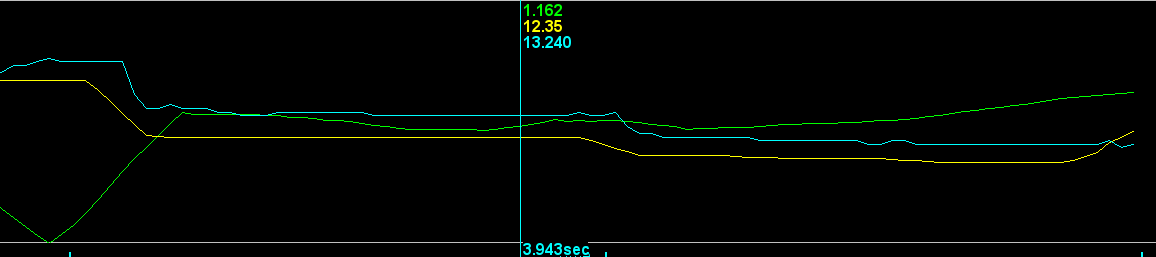
Let's review some real data from customer vehicles.

Right after install:

LTFT near zero
Reported airflow may look lower, because the way the air is crossing the MAF has changed.
Actual AFR is leaner than commanded
Fuel Trims (green) 1-3%, but AF desired (yellow) is richer than actual (blue)
2024 Tacoma Tuning Facts - Understand Your Truck Like We Do at CAMTuning 1774451599019-df


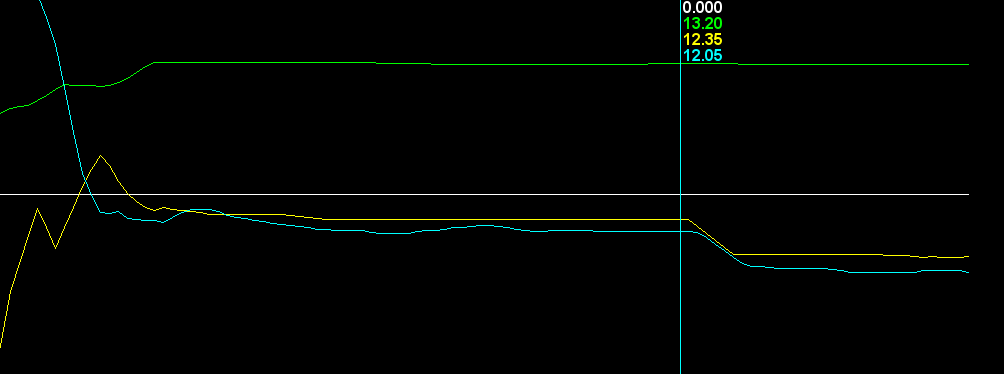
After some drive time:

Total fuel trims (mostly long term in this case) goes positive (adding fuel)
Commanded AFR and actual AFR line back up
“Extra power” goes away
Fuel trims (green) ~13%, but AF desired (yellow) and actual (blue) are well matched:


2024 Tacoma Tuning Facts - Understand Your Truck Like We Do at CAMTuning 1774451566328-7

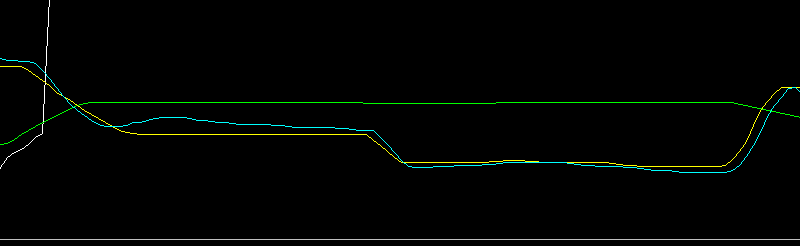
Properly calibrated fueling *after revision based on data logs- this is a real customer of mine, tuned remotely.
Fuel trims near 2% (green), AF desired (yellow) and actual (blue) well matched:
2024 Tacoma Tuning Facts - Understand Your Truck Like We Do at CAMTuning 1774451542064-kk

This is why airflow comparisons between intakes can show misleading data. If the MAF scaling isn’t correct, you’re not comparing airflow—you’re comparing sensor interpretation, and the engine running conditions are not a direct comparison.

Real gains from an intake come from reducing restriction pre turbo and improving how easily the turbo can move air. But if you see an immediate jump in performance without calibration changes, you need to wonder whether it’s actual airflow… or just a measurement shift.

Here's the key takeaway: airflow data only means something if the MAF is calibrated correctly.
 

nickyp

TRD Off-Road Premium
New member
First Name
Nick
Joined
Mar 3, 2026
Threads
0
Messages
3
Reaction score
0
Location
Canada
Vehicle(s)
4th Gen Off-Road Premium
Hi @CAMTuning I really appreciate the knowledge you are dropping here, so thanks!
I have a question (or two) I was hoping you could address.

How do the different drive modes actually work on a Tacoma? Mine has Eco, Normal, Sport and Tow/Haul. Do each of these have their own ECU and/or TCM maps, or is there just a base map that these modes add modifiers to?
Following up on that, if one was to have their ECU/TCM custom tuned, how do these modes then interact with the tune, or would they each need their own custom tune as well?

One other topic I believe you have mentioned before is the altitude compensation. How does that work? If it is altered for a higher altitude will you have problems if you then drive into lower altitudes?

Sorry for all the questions, just very curious!
 
OP
OP
CAMTuning

CAMTuning

TRD Off-Road
Well-known member
BASIC Sponsor
First Name
Cameron
Joined
Apr 2, 2025
Threads
14
Messages
232
Reaction score
295
Location
New Mexico
Vehicle(s)
2025 Tacoma TRD OffRoad
Hi @CAMTuning I really appreciate the knowledge you are dropping here, so thanks!
I have a question (or two) I was hoping you could address.

How do the different drive modes actually work on a Tacoma? Mine has Eco, Normal, Sport and Tow/Haul. Do each of these have their own ECU and/or TCM maps, or is there just a base map that these modes add modifiers to?
Following up on that, if one was to have their ECU/TCM custom tuned, how do these modes then interact with the tune, or would they each need their own custom tune as well?

One other topic I believe you have mentioned before is the altitude compensation. How does that work? If it is altered for a higher altitude will you have problems if you then drive into lower altitudes?

Sorry for all the questions, just very curious!
Hey Nick- Thanks for asking, because this is often misunderstood.

They’re not separate ECUs or totally separate tunes. It’s one calibration with multiple tables the truck switches between based on mode. They aren't modifies, but dedicated tables.

Some things are shared, some are mode-specific:

Driver demand and axle torque limits can be shared or mode-dependent
Trans is fully mode-based (shift schedule, torque converter lockup, etc.)
All of that lives in the same file, just different tables per mode.

When you tune it, you’re not replacing modes—you’re recalibrating them. Each mode still works, and you can adjust them individually within the same tune.

Altitude stuff is already built in and dynamic. The truck knows what ambient pressure is and uses that for compensation.

Wastegate duty changes with ambient pressure to hit boost targets.
Load limits vs RPM also change with altitude. It will naturally hit lower load with less air density.

You don’t “tune for one altitude.” The ECU adjusts in real time, so no issues going from high to low elevation as long as the calibration doesn't modify those strategies.
 

Will721

TRD Off-Road
Well-known member
First Name
Will
Joined
Nov 19, 2025
Threads
0
Messages
202
Reaction score
176
Location
Quad Cities
Vehicle(s)
2025 TRD OR
An observation about modes, eco mode appears to go deeper than just switching tables. If you turn your heat or A/C on high and switch from eco to any other mode, there is an observable increase in fan speed. I would assume that it does that to reduce overall load for fuel economy. I have been meaning to go test charging voltage to see if it's doing it by reducing overall voltage or if it's isolated to the blower motor.

It's been on my todo list for a bit to do some testing to see if there's any more differences than can be observed. Like sticking a camera in the grille to see when and how the shutters operate and things like that. I've never owned a vehicle as complex as these trucks and find it fascinating.
Sponsored


Top