Sponsored

Baltimore

Well-known member
Joined
Jul 23, 2024
Threads
29
Messages
667
Reaction score
375
Location
Maryland
Vehicle(s)
4g hybrid
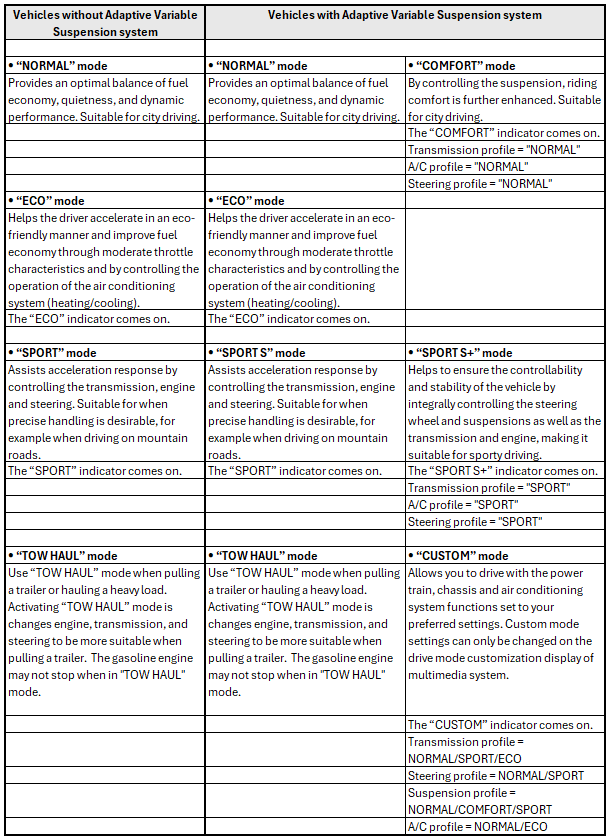
An observation about modes, eco mode appears to go deeper than just switching tables. If you turn your heat or A/C on high and switch from eco to any other mode, there is an observable increase in fan speed. I would assume that it does that to reduce overall load for fuel economy. I have been meaning to go test charging voltage to see if it's doing it by reducing overall voltage or if it's isolated to the blower motor.

It's been on my todo list for a bit to do some testing to see if there's any more differences than can be observed. Like sticking a camera in the grille to see when and how the shutters operate and things like that. I've never owned a vehicle as complex as these trucks and find it fascinating.

Only Normal/Comfort will restore automatically if the truck has been turned off for more than 10 minutes. Otherwise,
2024 Tacoma Tuning Facts - Understand Your Truck Like We Do at CAMTuning 1775055981808-1k
Sponsored

 
OP
OP
CAMTuning

CAMTuning

TRD Off-Road
Well-known member
BASIC Sponsor
First Name
Cameron
Joined
Apr 2, 2025
Threads
21
Messages
280
Reaction score
400
Location
New Mexico
Vehicle(s)
2025 Tacoma TRD OffRoad
Session 13: E30 Ethanol Tuning Explained: Power Gains, Fueling Changes, and How to Mix It Correctly

Since I've been tuning more trucks on an ethanol blend lately, I figured I'd add an entry here to cover that topic.

A lot of people think running E30 is just adding ethanol to make more power but it’s not that simple.

Ethanol does a few key things that change how the engine can be tuned:

Higher knock resistance → allows more ignition timing
Charge cooling effect → helps reduce combustion temps and knock
More stable power → less timing pull under load

That’s where the gains come from—but only if the calibration is set up correctly.

The Part Most People Miss: Fueling

Ethanol requires more fuel volume than gasoline.

So when tuning for E30, we have to adjust:

Fueling targets (lambda)
Injector and fuel system behavior

If this isn’t done right, you’re not getting the full benefit—and potentially creating inconsistencies.

Why Ethanol Content Matters

Pump “E85” isn’t actually consistent. It’s usually anywhere from E51–E85 depending on season and location.

So if you’re trying to run E30 and just guessing your mix:

You might actually be at E20 → less knock resistance than expected, and richer AFR
Or E40+ → more fuel demand than intended (leaner AFR)

How to Do It Right
  • Use an ethanol content sensor (fuel-it, innovate, etc) if you run blends regularly, and use an E85 mix calculator app when filling up
  • Try to stay consistent with where you get fuel
Why E30 Works So Well

When everything is set up correctly, E30 gives you:

  • More usable power (not just peak)
  • Better consistency under load
  • A safer margin compared to pushing pump gas

E30 isn’t just about adding ethanol—it’s about controlling it and tuning for it properly.

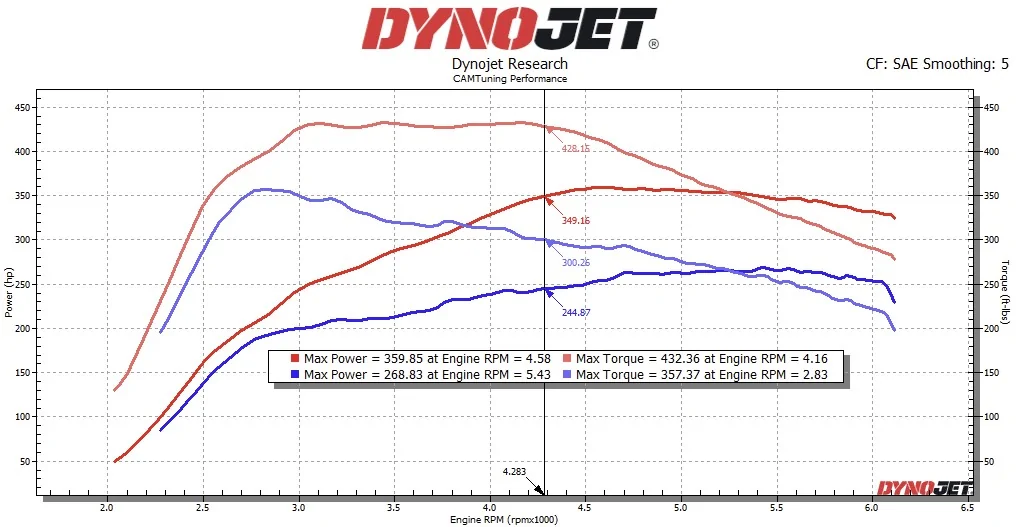
Here's an example on my personal truck on 91 (stock) vs an E30 blend. This is with an intake and intercooler as the only 2 modifications:
2024 Tacoma Tuning Facts - Understand Your Truck Like We Do at CAMTuning SXTH e30
 

redlimitediforcemax

Limited
Well-known member
Joined
May 2, 2025
Threads
1
Messages
58
Reaction score
48
Location
Oregon
Vehicle(s)
2024 Tacoma Limited I-force Max
An observation about modes, eco mode appears to go deeper than just switching tables. If you turn your heat or A/C on high and switch from eco to any other mode, there is an observable increase in fan speed. I would assume that it does that to reduce overall load for fuel economy. I have been meaning to go test charging voltage to see if it's doing it by reducing overall voltage or if it's isolated to the blower motor.

It's been on my todo list for a bit to do some testing to see if there's any more differences than can be observed. Like sticking a camera in the grille to see when and how the shutters operate and things like that. I've never owned a vehicle as complex as these trucks and find it fascinating.
In the limited trim, it allows you to customize your drive mode. You can mix ECO/NORMAL/SPORT engine response, suspension mode COMFORT/NORMAL/SPORT+, Steering set to NORMAL/SPORT+, and ECO/NORMAL Climate control. So what you're noticing is true, and on the limited trim you can select which Climate control profile you want to use. ECO being the more conservative use of the air conditioner system.
 
OP
OP
CAMTuning

CAMTuning

TRD Off-Road
Well-known member
BASIC Sponsor
First Name
Cameron
Joined
Apr 2, 2025
Threads
21
Messages
280
Reaction score
400
Location
New Mexico
Vehicle(s)
2025 Tacoma TRD OffRoad
Session 14: Stop Expecting Power from Cat-Back Exhausts


A cat-back exhaust is not a performance mod on a stock turbo truck- It’s a sound mod.

Cat-Back Reality Check

You can spend $1,000+ on a cat-back and gain… basically nothing.
  • No real horsepower gain
  • No meaningful torque change
  • No improvement in turbo efficiency

The truck doesn’t suddenly get faster. It just gets louder.

If it feels faster, that’s the noise talking.


Where Power Actually Comes From

The restriction isn’t at the back of the truck.
It’s right at the turbo.

That’s why the downpipe is the only exhaust part that consistently moves the needle:

  • Faster spool
  • More torque
  • Better airflow
  • Real, repeatable gains
This shows up in logs. It shows up on the dyno. Every time.
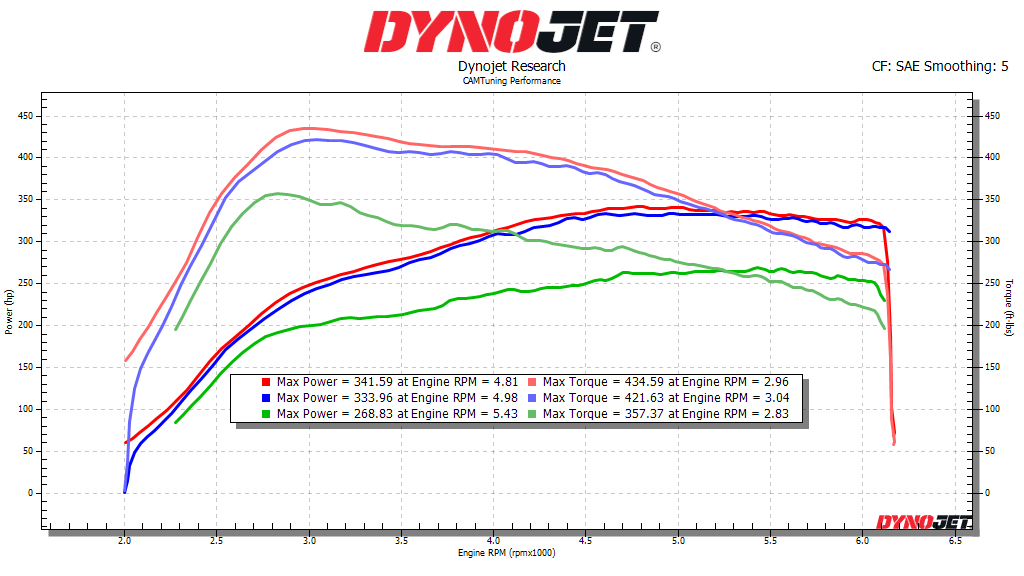
Green- stock truck
Blue- Intake, intercooler, stock downpipe, tune
Red- Intake, intercooler, FaF downpipe, tune

2024 Tacoma Tuning Facts - Understand Your Truck Like We Do at CAMTuning downpipe vs stock vs stockdownpipe


Common Mistake

People lump “exhaust” into one category and expect the same result.

It’s not the same:
  • Cat-back = noise
  • Downpipe = performance
Completely different impact.

And No…

A cat-back does not:
  • “Free up the engine” in any meaningful way
  • Suddenly add power because it’s “less restrictive”
  • Replace the need for actual airflow improvements

At stock turbo power levels, it’s not the bottleneck.

Bottom Line

If you bought a cat-back for sound, good—that’s what it’s for.

If you bought it expecting power, you bought the wrong part.

If you want actual gains:
  • Downpipe
  • Proper calibration
Everything else is just volume.

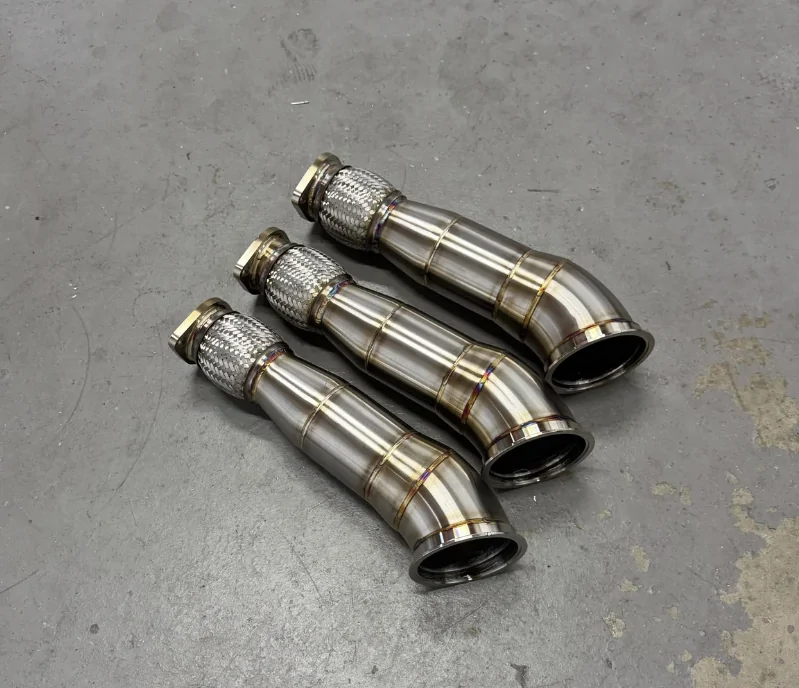
The highest quality, hand built in the USA downpipe is sold here:


FAF Race Downpipe


2024 Tacoma Tuning Facts - Understand Your Truck Like We Do at CAMTuning 1777309399559-7
 
OP
OP
CAMTuning

CAMTuning

TRD Off-Road
Well-known member
BASIC Sponsor
First Name
Cameron
Joined
Apr 2, 2025
Threads
21
Messages
280
Reaction score
400
Location
New Mexico
Vehicle(s)
2025 Tacoma TRD OffRoad
Session 15: The bottleneck isn't always where people think it is.

A larger intake only helps if something downstream can actually use the additional airflow. At some point, another component becomes the restriction.

That restriction might be the throttle body inlet. It might be the turbocharger itself.

Recent testing I performed showed something interesting: despite a much larger 5" intake design, gains over other systems became very small on stock mapping. That suggests the intake may no longer be the limiting factor at that power level.

Once other airflow restrictions are raised, the turbo itself may become the bottleneck.

We also saw a noticeable gain from a high-flow catted downpipe—which points toward the system working as a whole, not just one part.

Next on the list: throttle body inlet testing and eventually another turbo. @SXTH Element hurry up!

Airflow is a chain. The weakest link changes as power goes up.


Link to intake dyno testing thread
 

Sponsored

OP
OP
CAMTuning

CAMTuning

TRD Off-Road
Well-known member
BASIC Sponsor
First Name
Cameron
Joined
Apr 2, 2025
Threads
21
Messages
280
Reaction score
400
Location
New Mexico
Vehicle(s)
2025 Tacoma TRD OffRoad
Session 16: Air Leaks, Fueling, and Why Leak Testing Matters
As more people install intakes, charge pipes, intercoolers, throttle body pipes, and other airflow-related parts, air leaks are becoming more common.

The important thing to understand is that not all air leaks act the same. Where the leak is located completely changes how it affects fueling, drivability, boost, and power.

On a MAF-based turbo vehicle like the 4th Gen Tacoma and 6th Gen 4Runner, the ECU is making fueling decisions based heavily on measured airflow. If air enters or exits the system somewhere it should not, the ECU’s calculation no longer matches what the engine is actually receiving.

That can cause lean conditions, rich conditions, poor fuel trims, inconsistent boost control, reduced power, rough idle, exhaust popping, and sometimes a check engine light.

1. Pre-turbo air leaks

A pre-turbo leak is between the MAF sensor and the turbo inlet.

This can be an intake coupler, turbo inlet pipe, clamp, fitting, or anything else that allows air to enter after the MAF sensor.

This is unmetered air. The MAF measured one amount of air, but the engine is actually ingesting more than that because air is entering downstream of the sensor.

At idle, cruise, and low load, this often shows up as positive fuel trims. The ECU sees the mixture trending lean and adds fuel to correct it.

In more severe cases, you may see lean air/fuel behavior, unstable trims, rough idle, popping from the exhaust, or drivability issues that are hard to tune around.

2. Post-turbo leaks: turbo to throttle body

This is what most people think of as a “boost leak.”

This includes the compressor outlet, charge pipes, intercooler, intercooler couplers, clamps, and the pipe leading to the throttle body.

On these trucks, pay attention to the charge pipe connections. They use a slip-style connection with a specific seal instead of a normal coupler and clamp. If that seal is mis-installed, pinched, damaged, or forgotten, it can leak even though everything may look assembled correctly from the outside.

When the truck is in boost, this area is under pressure.

If air leaks out here, that air has already been measured by the MAF, but it never makes it into the engine. The ECU adds fuel for air it thinks the engine is receiving, but some of that air is escaping.

That can create a rich condition under boost.

It can also cause lower-than-expected boost, slower spool, unstable boost control, higher wastegate duty, reduced torque, poor throttle response, and inconsistent power. Sometimes the truck just feels soft or lazy even though nothing obvious looks wrong.

At light load, this same area may not show up the same way. Depending on throttle angle and pressure, parts of the charge system may not be under meaningful boost. That is why some leaks only show up under load.

3. Post-throttle body leaks: throttle body to intake valve

This area can be tricky because it can behave differently depending on load.

This includes the intake manifold, manifold gasket, vacuum lines, MAP/TMAP sensor seals, brake booster line, EVAP connections, and anything else connected to the manifold.

At idle and low load, the intake manifold is usually under vacuum.

If there is a leak here, the engine can pull in unmetered air. That usually creates a lean condition and positive fuel trims because the ECU has to add fuel.

At higher load or boost, that same leak may become a pressure leak. Now air can escape from the manifold instead of being pulled in.

Depending on the size and location of the leak, this can cause rich behavior, reduced boost, reduced torque, inconsistent fueling, rough idle, exhaust popping, or a check engine light.

This is why air leaks are not always simple. The same leak can look lean in one part of the log and rich in another.

Why this matters for tuning

Fuel trims are not just numbers to ignore.

Positive trims usually mean the ECU is adding fuel because it sees the mixture as lean.

Negative trims usually mean the ECU is removing fuel because it sees the mixture as rich.

But the reason behind those trims matters.

A bad MAF calibration, different intake design, exhaust leaks, sensor issues, and air leaks can all influence the data. That is why I look at the whole picture instead of chasing one number.

A tune cannot properly fix a mechanical air leak.

You can sometimes compensate around a small issue, but that does not mean the truck is right. If the airflow path is leaking, the ECU is working from bad information.

That affects consistency, safety, and power.

Smoke testing

If you are installing an intake, charge pipes, intercooler, turbo inlet, throttle body pipe, or anything else in the airflow path, a proper leak test is worth doing.

A visual inspection is not enough.

A coupler can look seated and still leak.
A clamp can feel tight and still not seal.
A fitting can be slightly loose.
An O-ring or seal can be pinched, damaged, or missing.
A vacuum line can be cracked.
A throttle body or manifold connection can leak only under certain conditions.

The best option is a pressurized smoke test. That puts smoke into the intake or charge system under controlled pressure so leaks become visible.

For people doing their own installs, a decent smoke tester is a good tool to own. For everyone else, paying a shop to do a proper pressurized smoke test is money well spent.

Especially after installing charge pipes or an intercooler.

Key takeaway

  • Air leaks do not all behave the same.
  • A leak before the turbo can add unmetered air and create lean behavior.
  • A leak after the turbo can lose already-metered air and create rich behavior under boost.
  • A leak after the throttle body can act lean under vacuum and act differently once the manifold is pressurized.

Remote tuning works very well when the truck is mechanically sound. But when the airflow path has a leak, the data usually shows that something is off.

Before blaming the tune, the intake, the intercooler, or the truck itself, verify the system is sealed.

Smoke test it. Pressure test it. Confirm it.

Then tune from good data.
 
OP
OP
CAMTuning

CAMTuning

TRD Off-Road
Well-known member
BASIC Sponsor
First Name
Cameron
Joined
Apr 2, 2025
Threads
21
Messages
280
Reaction score
400
Location
New Mexico
Vehicle(s)
2025 Tacoma TRD OffRoad
Session 17: What I've Learned After Tuning Triple-Digit 4th Gen Tacomas and 6th Gen 4Runners

It has been a while since I have put together a Tuning Fact post, and at this point there is enough real-world data to step back and summarize some of the biggest lessons from this platform.

These posts started as a way to help owners better understand the terminology, process, and decisions involved in tuning these trucks. The goal was to make the subject less intimidating, explain what is actually happening in the calibration, and give owners a clearer idea of what to expect before, during, and after the tuning process. Since then, I have tuned triple-digit 4th Gen Tacomas and 6th Gen 4Runners across a wide range of climates, elevations, fuel grades, modifications, tire sizes, and real-world uses.

I have also continued development on my own truck through street testing, datalogging, dyno testing, stock-turbo development, upgraded-turbo testing, and multiple hardware configurations.

At this point, some clear patterns have emerged.

1. The Factory Calibration Is Not Automatically the Safest Calibration
Factory calibrations are built to satisfy a long list of requirements, including emissions, fuel economy, fuel quality, drivability, component protection, manufacturing variation, and compatibility with a wide range of fuel quality.

That does not mean every part of the factory calibration is ideal.

One of the most concerning things I consistently see is very lean factory fueling under boost. Proper tuning can improve fueling, torque delivery, throttle behavior, ignition strategy, and overall consistency while retaining the ECU’s factory safety systems.
A properly developed tune should not disable the ECU’s ability to protect the engine. It should give those systems a better calibration to work from.

2. A Tune Is Much More Than Adding Boost
Boost is only one part of the equation.

Fueling, ignition timing, load targeting, throttle control, torque modeling, temperature compensations, knock response, wastegate control, and transmission behavior all work together.
Two trucks can reach similar peak boost while producing very different power, response, consistency, and drivability.

3. Every Truck Does Not Respond Exactly the Same
Even two trucks with the same modifications can behave differently.

Fuel quality, ethanol content, elevation, weather, tire size, mechanical condition, learned values, and normal production variation can all affect the result.
That is why I review datalogs and make revisions instead of treating every vehicle like a copy-and-paste flash.

The base calibration may be developed from a large amount of testing, but the final result should still be verified on the actual truck.

4. Intakes Do Not Always Require Tuning, but Tuning Is What Unlocks the Real Gain
Many of the supported intake systems can be installed without immediately creating a dangerous condition. That does not mean the intake alone provides the same benefit as a calibration developed around it.
The hardware increases airflow potential. The tune determines how effectively the engine uses that airflow through load targeting, boost control, fueling, ignition timing, and torque management.

5. 87, 91, and 93 Maps Should be unique
A proper fuel-specific calibration should reflect the actual characteristics and limitations of that fuel.

That can include changes to load targets, ignition timing, knock margin, fueling strategy, torque delivery, and temperature sensitivity.

The ECU can adapt within a certain range, but adaptive learning is not a replacement for the correct base calibration.

6. Hot Weather Does Not Automatically Make a Proper Tune Unsafe
The ECU monitors far more than outside temperature.

Air temperature, coolant temperature, oil temperature, knock feedback, load, and many other conditions are continuously evaluated. A proper calibration retains and develops around those compensations.

The truck may produce less power in extreme heat, which is normal. The goal is not to force the same output in every condition.

The goal is predictable, controlled operation across the conditions the truck will actually experience.

7. Remote Tuning Is Not a Compromise When the Process Is Done Correctly
Remote tuning is at the core of my business.

The customer works directly with the calibrator, collects data from the actual truck, and receives revisions based on what that data shows.

Geographic distance matters far less than the quality of the data, the testing process, and the person interpreting it.

8. Dyno Results Are Only as Honest as the Testing Procedure

This one is worth some focus: Peak dyno numbers do not tell the whole story.

Different dynos, correction factors, weather conditions, tire sizes, gear selection, transmission behavior, and test procedures can all change the number shown on the graph.

Baseline selection matters too.

A vehicle’s first dyno pull is often its weakest or least representative because the ECU, transmission, temperatures, or overall test setup may not yet be fully settled. Unfortunately, that low first pull can also be intentionally used as the baseline to exaggerate the apparent gain from tuning.- I do not test that way.

I normally use the second or third repeatable pull as the baseline, never the first pull, and compare it against repeatable tuned results under the same conditions.

That may create a less dramatic before-and-after graph, but it gives a much more honest representation of what the calibration actually gained.

Peak horsepower is still only one part of the result. Area under the curve, torque delivery, response, consistency, repeatability, and heat behavior often matter more to how the truck actually performs and drives.

9. The Tune Should Be Built Around How the Truck Is Actually Used
The best calibration is not always the one that produces the highest possible dyno number.

Daily driving, towing, off-road use, available fuel, elevation, tire size, climate, and the owner’s priorities all matter.

A truck that spends its life towing at elevation may need a different strategy than one built primarily for performance driving at sea level.

The Biggest Takeaway
The biggest lesson from tuning this many trucks is that there is no substitute for real data.

The clearest conclusions come from consistent testing, careful datalog review, and repeatable results across different trucks, modifications, fuel grades, climates, and driving conditions. That is what allows the calibration process to keep improving as more vehicles are tuned and more information is gathered.

That has been my approach from the beginning: develop on the platform, test honestly, review the data, and work directly with each customer until the result is where it should be.
Sponsored


Top