

I don't drive my truck so often (being retired has that effect) so after 7 mos I only have 2600 miles on the clock. Maybe at the 5k mark I'll do the whole job.
Sponsored
So many variables; e.g. mine did not shear with the same oil & engine. Need more UOAs from these engines to really know the answer to that question. I think the point is whether or not it does you're likely good-to-go until 10K for changes BUT not much more. Most here will stick to the change interval they feel comfortable with -- and all will argue why the other is wrong lol.The Toyota oil sheered out of grade but what about other synthetic oils like Mobil 1 Truck and SUV oil. Or Pennzoil Ultra?
Just because one brand sheered out of grade doesn’t mean they all will.
Most wear happens at start up.
0W-20 flows faster at start up than 5W-30.
And that's why 0W-30 is the right choice.The Toyota oil sheered out of grade but what about other synthetic oils like Mobil 1 Truck and SUV oil. Or Pennzoil Ultra?
Just because one brand sheered out of grade doesn’t mean they all will.
Most wear happens at start up.
0W-20 flows faster at start up than 5W-30.

Oil threads be like:



In this video he states that 5w-30 is twice as likely to sheer out of grade than 0w-20Hmmm...the 0w20 sheared out of grade...? What have we been shouting from the roof tops, but nobody listens. My bet is that mr speed will be putting 5w30 in his Tacoma post 10k miles.
But I am sure some on this thread would prefer to go "with their gut" and use 5w-30.In this video he states that 5w-30 is twice as likely to sheer out of grade than 0w-20
My bet is he changes brands and uses a better 0w-20 oil

If you’re going to use his words to make a point, at least use all of them. He said that with 5W-30, while it may be more likely to shear out of grade, it doesn’t seem to matter when it does vs when 0W-20 shears, it’s detrimental and causes increased wear. He also said that once he’s past the break in, if he finds a 20 grade oil to be what he chooses to run long term, it’ll be 5W-20, not 0W-20, because he just plain doesn’t have any reason to need or want 0W-20 where he lives. Which is especially reasonable because 5W-20 is one of the most stable grades. There is zero benefit and potential drawbacks to running 0W-20 when 5W-20 exists readily and if someone lives in a climate that doesn’t get down to Antarctica temps.In this video he states that 5w-30 is twice as likely to sheer out of grade than 0w-20
My bet is he changes brands and uses a better 0w-20 oil

You put more effort into that reply than into backing your argument.Dennisd
After reviewing your ‘loss of sleep,’ we’ve consulted and determined there’s clearly a full-blown emergency impacting your health. So, in the interest of your well-being, we’re officially allowing you to use 0W-20.
Try to rest easy—and for everyone’s sake, please refrain from diving into threads that threaten your delicate sense of well-being. We wouldn’t want this situation escalating beyond motor oil again.
(In the future if you need any further permissions we'll be happy to take them under consideration, so dont hesitate to ask.)


Yeah, and despite that, it would still make perfect sense to go with 5-30. "Gut instinct" has nothing to do with it.But I am sure some on this thread would prefer to go "with their gut" and use 5w-30.
You’re not wrong about HTHS existing—you’re wrong about what it proves.Yeah, and despite that, it would still make perfect sense to go with 5-30. "Gut instinct" has nothing to do with it.
The reason it's more likely to shear out of grade is the gap between the base weight and the operating viscosity. More viscosity modifiers are required to take a 5w base weight oil to 30 than 0w base weight to 20.
Here for example, is what chat gpt had to say regarding the difference between Restore and protect 0-20 and 5-20.
Unless you NEED the cold-flow of a 0w and the minor improvement in fuel consumption, there isn't a downside to going with a thicker oil.
What HTHS means: it is the oil’s viscosity under very hot, very high-shear conditions that better simulate what happens in loaded engine areas such as bearings, cam/lifter interfaces, and ring zones. It is measured at 150°C and about 1,000,000 s⁻¹ shear rate, so it is much more representative of “real protection when the engine is hot and working” than ordinary kinematic viscosity alone.
Restore & Protect 0W-20 at 2.65 cP
This would be a fairly fuel-economy-leaning 20-grade. It would still meet the SAE 20 hot-shear floor, but it would sit close to the minimum, suggesting Valvoline optimized it more toward low drag / efficiency / cold-flow friendliness than toward maximum hot-shear thickness. That does not mean it is “bad” or unsafe if your engine is designed for it; modern OEMs often specify oils in this range intentionally.
Restore & Protect 5W-20 at 3.17 cP
This would be a much stouter oil under load than most people expect from a 20-grade. A 3.17 cP HTHS sits well above the SAE 20 minimum and even overlaps the broader low-HS/low-SAPS European fuel-economy territory where minimum HTHS is often 2.9 or higher, depending on spec. In practice, that would usually mean thicker oil film under hot load, potentially a little more margin for wear control, noise damping, and oil consumption resistance, at the possible expense of a bit of fuel economy.
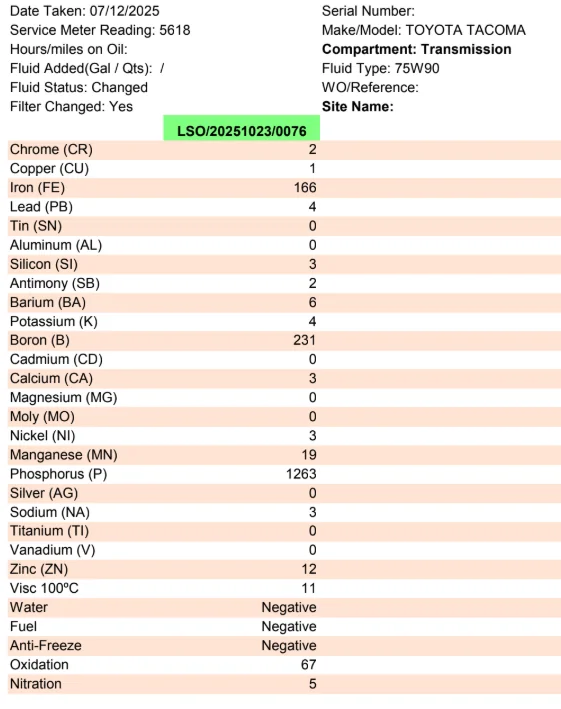
Back to the original topic, I drained all driveline fluids at 5kish, and again at 10k and was glad I did.
Diff oil was darker than I expected and I had some metal shavings on the magnetic drain plug.
Ignore the transmission listed in the sample, I wrote down trans, but this was from my diff.
It's a no-brainer imo to drain fluids for someone that plans to own the vehicle long term,.