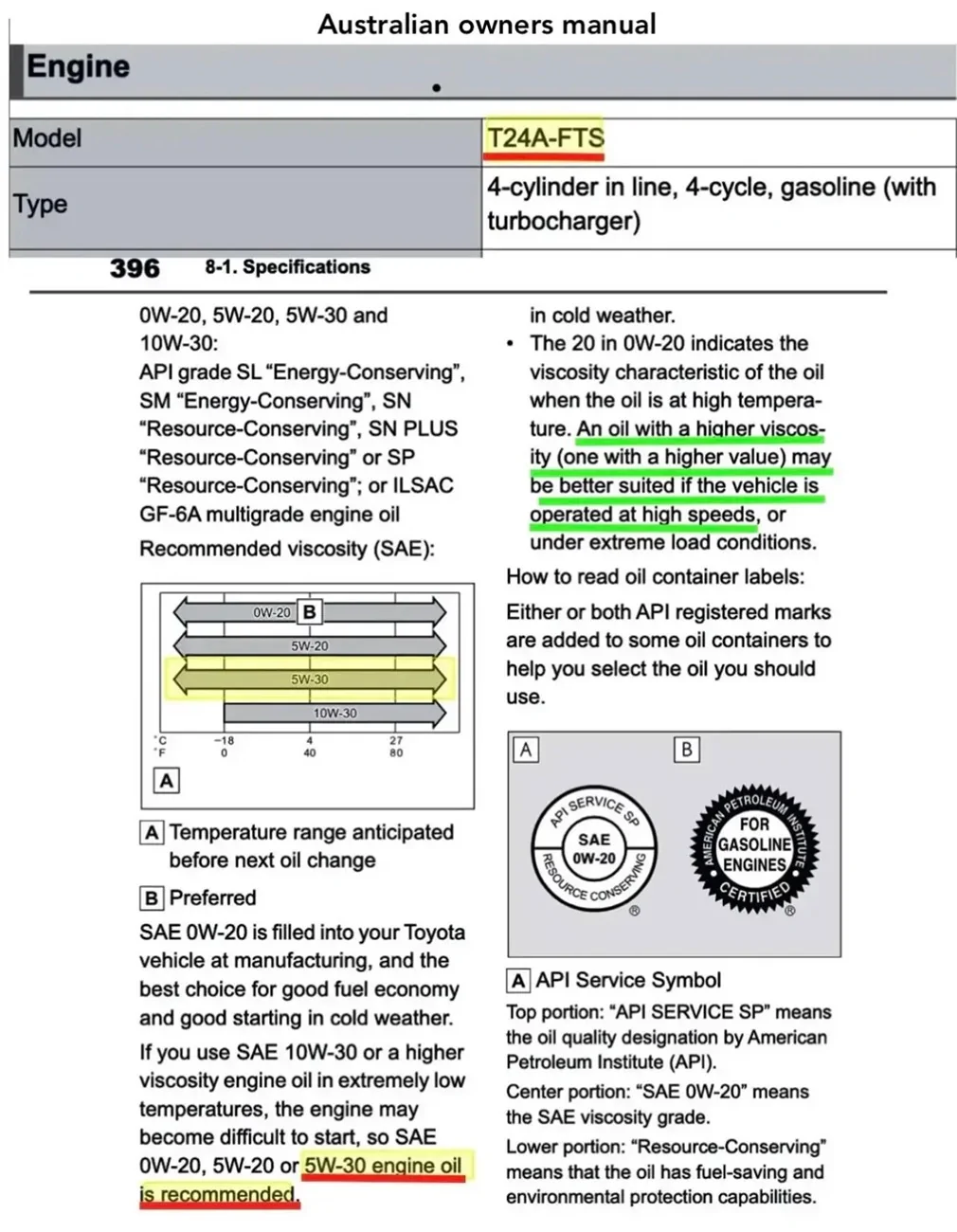


I completely agree that CAFE may influence Toyota's North American viscosity recommendation. I've never argued that fuel economy regulations play no role in these decisions.As you wrote, this undermines Dennis’s argument.. and again, my contention that Toyota only recommends 0w20 for CAFE rating. To the credit of Dennis, he want more than my anecdotal evidence, and he is correct. When oil samples are tested for this engine, making a comparison, then we will have an empirical answer. With heat management being a concern in hotter environments, it seems likely that Toyota offers oil viscosity as high as 10w30 for hot climates. Since the United States has the same high temps, like in Arizona as compared to Mexico, it begs the question as to why Toyota would only recommend 0w20 in the United States for this engine- to me. It is a logical argument but can only be verified by a Toyota power plant engineer familiar with the decision for only 0w20 for the United States, vs Mexico/spain/russia, etc…. Or an oil comparison test, on this engine.
Where I think we still differ is that proving CAFE influences the recommendation does not automatically prove that 5W-30 produces better durability outcomes in the T24A-FTS.
Those are two separate questions.
In fact, I think your last paragraph actually supports my position. You said the argument can only really be verified by a Toyota engineer involved in the decision or by actual testing on this engine.
That's exactly why I've been hesitant to make strong claims about 5W-30 being superior.
At this point, I think the evidence supports the idea that Toyota considers multiple viscosities acceptable globally. What I don't think has been demonstrated is that North American owners running 0W-20 are sacrificing meaningful durability by following the factory recommendation.
That's the leap I've been questioning all along.
Sponsored