

- Thread starter
- #1

For those new to Banks... this post may seem controversial.
We’ve engineered cold air and ram-air intakes systems, fluid cooling products, turbochargers, tuning, and related performance systems for nearly seven decades. Our work spans boats, cars, pickups, racing, OEM, and defense applications where durability is not optional. That background is why we test the way we do: instrument the system, isolate the variable, measure the result, and only release the part when it beats stock and all competitors. The result is the Banks Ram-Air Intake System.
For the 2024–2026 Tacoma and 2025-2026 4Runner with 2.4L i-FORCE and iFORCE Max, we bought the competitors intakes, tested and dissected them. We scanned the truck for fitment, which is where many brands stop. Then, we instrumented the entire airflow path, from grille to exhaust pipe. Every pressure, temperature, speed and delta was measured, calculated and recorded at 25 samples per second in an iDash Data Pro mounted in the cab on the A-pillar. This was OE-level testing. There were no unknowns.
A Tacoma intake has a simple job, but doing it right is not simple.
- Increase air mass to the turbocharger compressor. By doing so, increase power and/or fuel efficiency.
- Maintain or improve air filtration
● Increasing filter area without choking flow
● Keeping engine-bay heat out
● Avoiding sharp corners where air pressure is lost
● Keep the Engine Control Module (ECM) (No check engine lights)
● Sealing correctly to the hood
● Draining water properly
● Fitting the Trailhunter snorkel the way Toyota intended
That last one speaks to competitors’ race to market. In their haste, they either did not procure a Trailhunter to 3D scan the Toyota snorkel interface. Therefore, none that we’ve tested mate with the interface properly. One would call this lazy engineering. You'll see this topic again later in the story.


Safe Power Gains
On our dyno, the Banks Ram-Air intake made. These results can be repeated by anyone with a dynamometer. In fact, a few have already tested the Ram-Air Intake and have recorded gains greater than our claimed increases.
● 18.3 hp best gain
● 17.7 lb-ft best gain
Could we have achieved a bigger gain? Yes, but not safely.
There is a line we will not cross. We will not damage or negatively affect an engine’s longevity. In a gasoline engine, more air means more heat. Maintaining a proper air fuel ratio is critical for power, fuel economy, and engine life. Gale Banks has long lived by the Hippocratic Oath, thou shall do no harm.


TRD Pro and Trailhunter
All Tacoma trim levels share the same Mass Air Flow (MAF) calibration except TRD Pro and Trailhunter. These are equipped with a TRD Pro intake with a larger cross-sectional area at the MAF sensor. In short, these two trucks require a different intake tube. Any manufacture that claims their intake will work with all trim Tacoma trim levels is, well, lying. Or, they’re not scared of check engine lights and reduced engine power. The Ram-Air Intake for TRD Pro and Trailhunter is currently in R&D and coming soon.
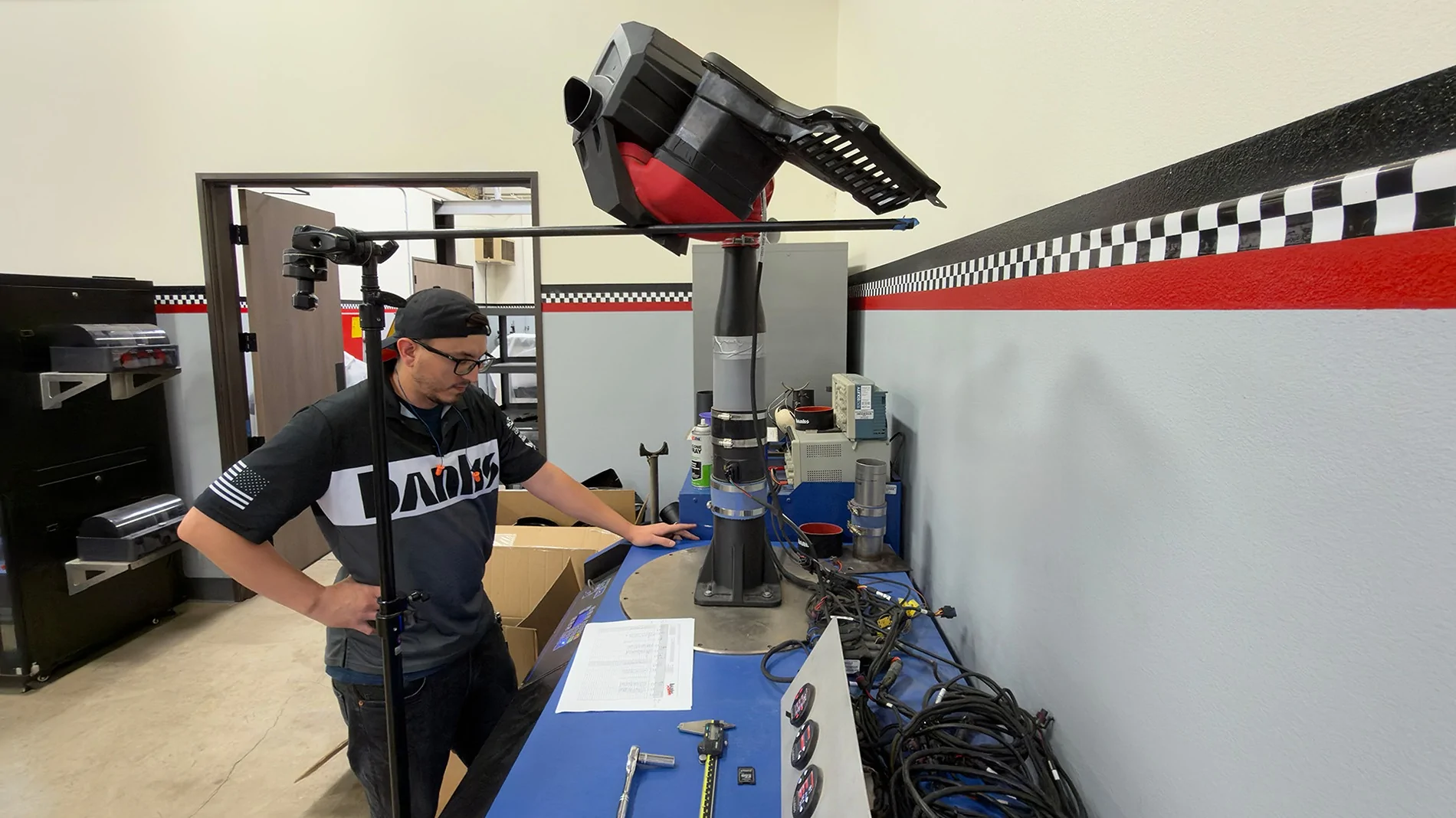

Airflow path
The stock intake path is not just small. It's bent like a sink trap, making 270° in turns before reaching the filter. Air doesn’t like corners. Corners force air to act as if it’s being restricted through a smaller diameter.
The Banks intake tube takes a smoother route into the turbo. Less turning. Less pressure loss. Less work for the turbo to draw in the air it is asking for.
This is where shape matters. A tube can look big from the outside and still be poor from an airflow standpoint if the path is abrupt, pinched, or full of direction changes.

Filter size matters
Filter size is not just about marketing. It affects pressure drop, dirt capacity, service interval, and how hard the turbo has to pull through the media.
A larger filter gives the air more surface area to pass through. That reduces restriction and spreads dirt loading across more media instead of concentrating it in one small area.
Pleat count and pleat depth matter too. More usable media area means the filter can move more air with less pressure loss while holding more dirt before service is needed.

That is why we built the Tacoma Ram-Air around a large filter and a large, enclosed housing instead of just dropping a small cone into a box and calling it done.
But filter design doesn’t end there. The outlet is important. What good is a lot of filter surface area if it can’t easily flow into the intake tube? Think of a baby trying to drink of a 40oz Big Gulp. It’s not gonna make it all in his mouth without some work.
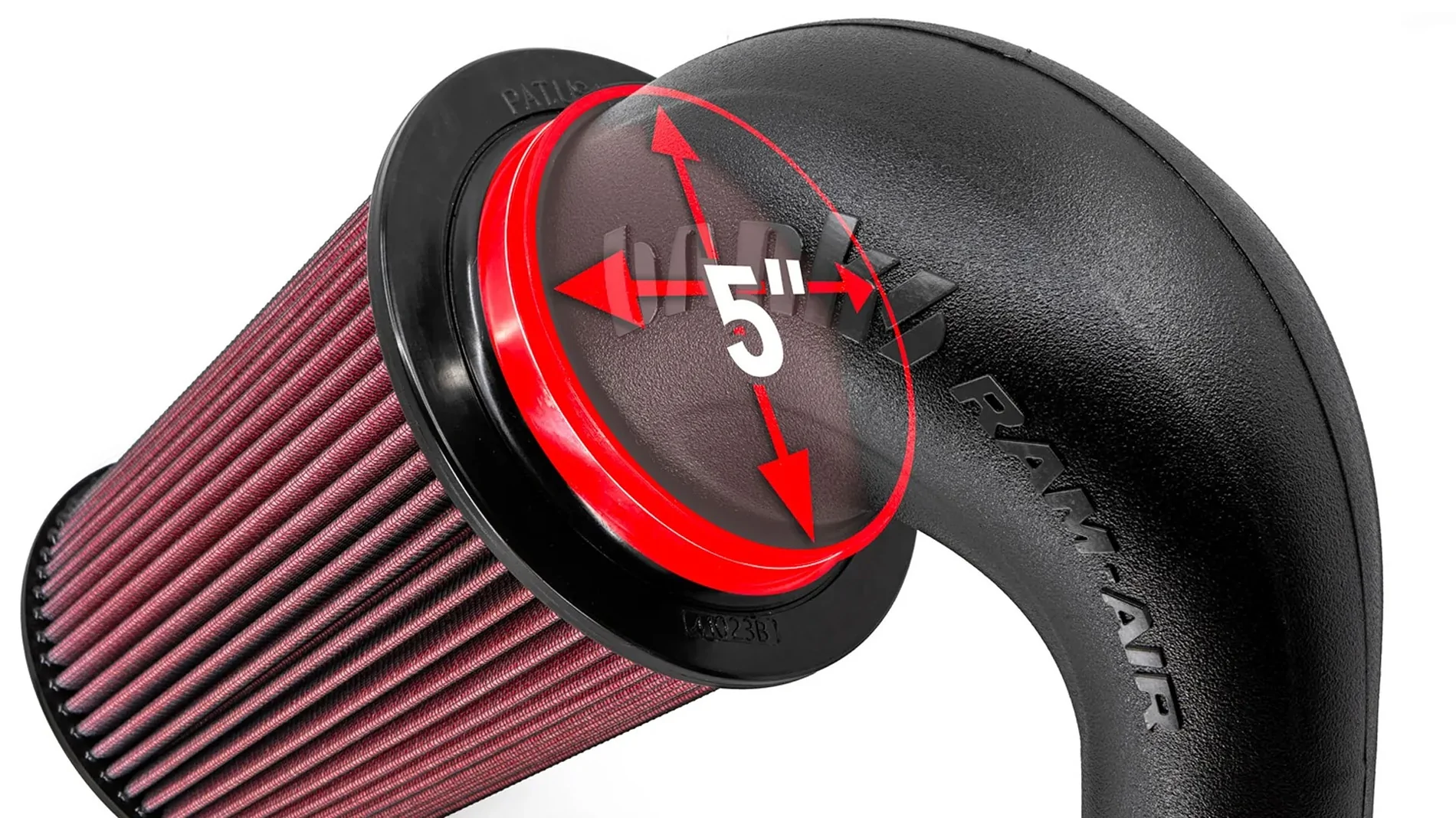
The filter outlet should be as large as possible. This means the intake tube must also be as large as possible. This creates a problem for engineers because the tube must maintain a near-stock cross-sectional area at the MAF sensor or suffer a check engine light. To overcome this, we’ve used fluid dynamics pioneered by NASA known as a "NACA bend." (NACA was renamed NASA in 1958, the same year Banks was founded.)
Filtration
According to our research, Tacomas are driven off-road more than any other trucks. For this reason, we engineered a 99.25% efficient filter element specifically for this application. From selecting the specific synthetic cotton gauze, the number of layers, pleat count and pleat depth, to the amount of oil —everything inch of our filter was purpose built for the Tacoma.
Bart, the owner of a '24 TRD Off-Road recently checked the status on his Banks filter element. After 15,200 miles, the exterior of the filter's surface area was coated in dust as expected. However, he was delighted to find no debris inside the filter. This is further proof that the Banks filter handle the dustiest of environments.
Trailhunter snorkel fitment
This is one of the clearest examples of why being first to market does not always win the race.
The Trailhunter comes fitted from the factory with a factory snorkel. That means the intake housing seals to the snorkel via an interface mounted to the inner fender.
SXTH’s own product page says their intake fits Trailhunter/TRD Pro, but tuning is required and it “does not seal watertight against the snorkel.” It’s not that it doesn’t make a watertight seal. It’s that it doesn’t mate at all.
That is not a small detail on a truck built for trail use.
Here is SXTH's fitment issue:


The seal matters because the snorkel is part of the intake system. If the box does not mate correctly, the truck is not pulling air the way the factory snorkel was designed to feed it. Looing at the side inlets below, none will mate with the Toyota's snorkel interface.
But we get it. Few people will cut a hole in their fender for a snorkel. But that's not the point. The point is that these companies didn't bother to get a truck and test it. They just guessed.

Keeping heat out
The Banks intake housing is fully enclosed and uses an injection molded rubber seal against the hood. It mates perfectly. The plastic housing and intake tube is thick by design to help reduce heat transfer the intake air.
That is one of the differences between a sealed intake and a hot-air intake with a lid.
K&N uses a foam lid approach which not only allows hot air into the intake, it promotes it. They may want consider renaming it, a hot air intake. Mishimoto uses foam tape to seal to the hood. When we received ours, the double side tape was already peeling off the slipper plastic. SXTH uses a rubber edge seal similar to what you would see on a car door.
Our approach is different: enclosed molded housing, molded rubber hood seal, large filter, smooth inlet path, and proper integration with the truck.
Water Drainage
A Tacoma intake should be able to deal with water.
The Banks intake housing has drainage at the scoop and large drain openings at the lowest point of the housing. Water should not pool up in the bottom of the intake housing. If water makes it into the engine, it can hydro lock. Proper drainage should be a base-level engineering concern. Apparently some missed the memo.

Sound
The Ram-Air Intake adds a please turbo whistle when under heavy load from 2,200-3200 RPM when air mass flow is the highest. In other words, you'll hear it when you're lugging up a hill before downshifting. There is no drone in the cabin.
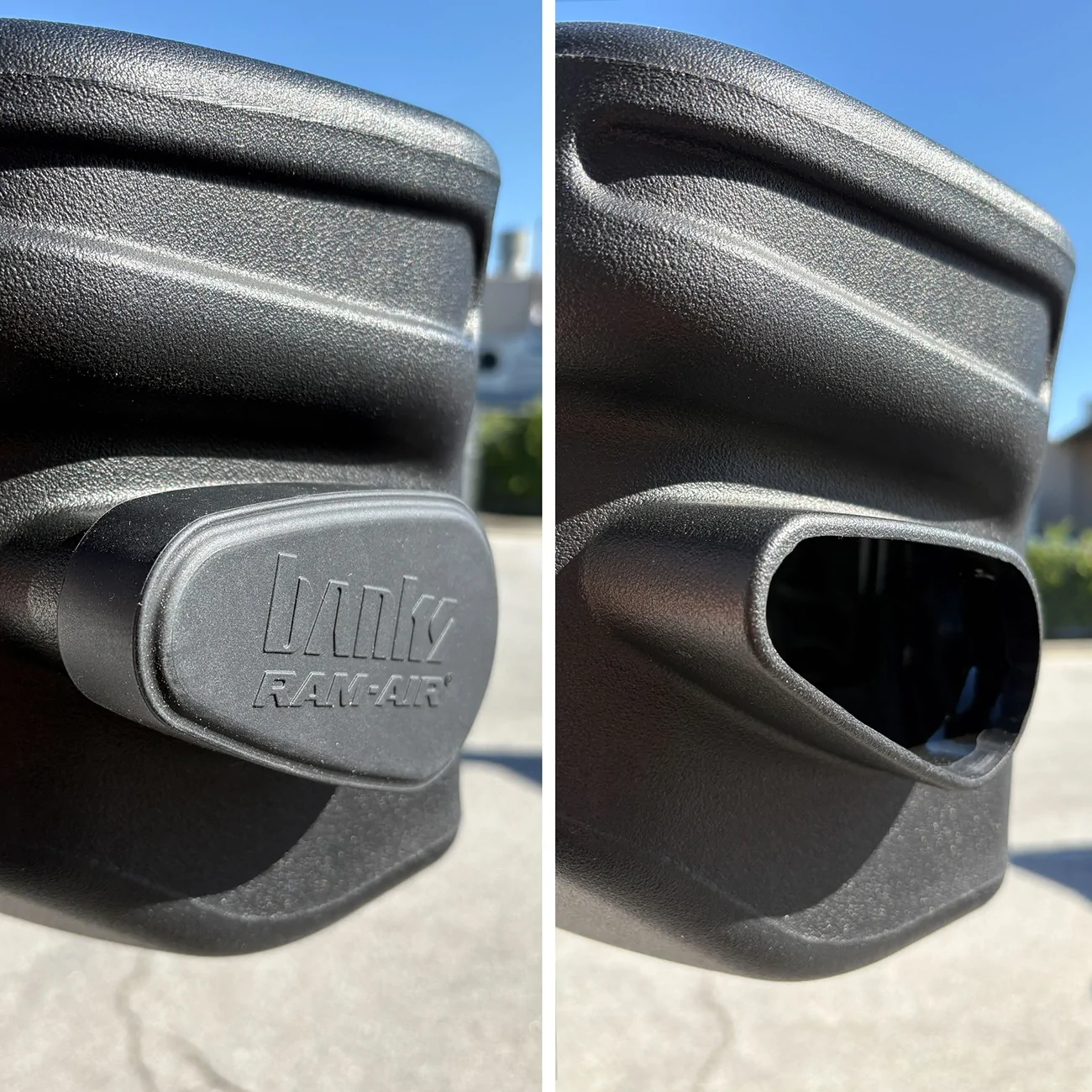
For those looking for more turbo sound, the Banks side inlet cover can be removed to allow more sounds to escape the housing. The sound will travel through the inner fender and into the cabin. With the inlet cover removed, the Banks Ram-Air offers similar sound output as SXTH and K&N, while still outperforming them.
Value
The goal was to build the best-performing, best-fitting, most complete intake system for the 2.4L Tacoma platform. That means proper R&D, dyno testing, road testing, competitor testing, snorkel integration, sealed construction, a large properly filter, and an unobstructed airflow path.
If you want a sealed intake that adds dyno proven horsepower, fits the truck properly, works with the Trailhunter snorkel, keeps heat out, drains water correctly, and is engineered as a complete system, that is what we offer.
Questions are welcome.
Sponsored
Last edited: