
Sponsored

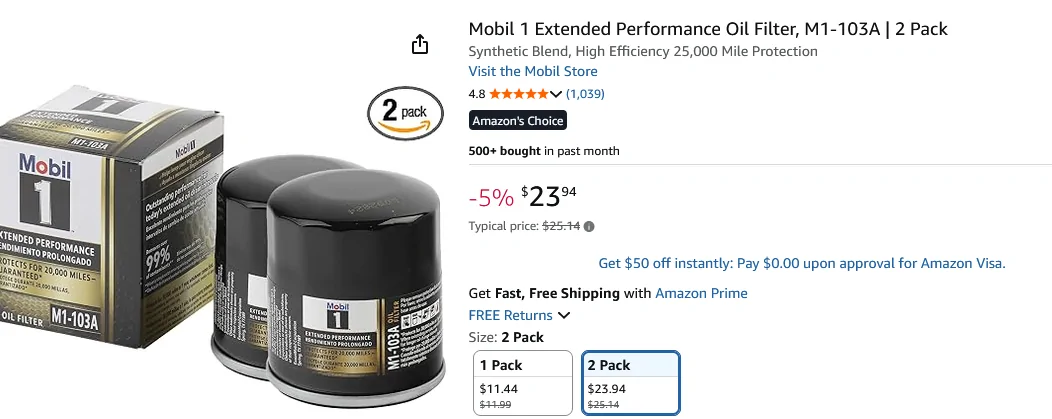
Mobil 1 Extended Performance Oil Filter, M1-103A | 2 Pack $24

OminousSkitter

Trailhunter
Well-known member
First Name
David
Joined
May 21, 2026
Threads
0
Messages
143
Reaction score
102
Location
Alaska
Vehicle(s)
Tacoma
As pictured, a 2 pack is $23.94 and a 1 pack is $11.44. Why would you buy the 2 pack for more than it costs to buy two 1 packs?
 

Sponsored

OP
OP
PullinDoubles

PullinDoubles

TRD Off-Road
Well-known member
First Name
Bobb
Joined
May 29, 2024
Threads
9
Messages
99
Reaction score
81
Location
Washington
Vehicle(s)
2024 Toyota Tacoma TRD Off-Road i-FORCE MAX
For $24 I can get 5 Toyota filters. I don't think Denso makes a "garbage" filter. You do you.
Its a fact there denso junk. Just so you understand. If that's what you can afford for your engine that's fine.
 

Mercedes

TRD Sport
Well-known member
Joined
May 27, 2026
Threads
0
Messages
85
Reaction score
89
Location
≈39N
Vehicle(s)
2026 TRD Sport "Mercedes"
Disclosure: I am not using a Toyota-branded filter. I am using one from a large vendor that rates well.

I hadn't considered the Denso filter before. I did some reading-up and watched a few tear-down videos this morning.

One thing I learned is Denso makes Toyota-stamped filters and Denso makes Denso-stamped filters. The Toyota filter is made in Thailand to the Toyota standard. The Denso filter is made in China. There are differences. Several videos available will highlight those.

Something I could not find of the Toyota filter is the micron efficiency rating. That's not unusual. Many vendors claim "99% (or other) efficiency", sometimes with additional information in the footnotes, or sometimes not at all. Filters with different PN#s in the same class by the same vendor can test differently.

For general purposes, severe duty or filters with the greatest efficiency will often test at 99%, when capturing particles 20 microns (um) and larger. Something used for extended service intervals might test at 99%, 30 um and larger. Finally, a racing-type filter might be 99% at 40 um and larger.

For any of the three, I don't consider one better than the other. They each have their own traits, for their own purpose. The one filtering the most, it's probably not a good idea to leave that on for 10,000+ mi / 16,000+ km interval. While the racing filter is only picking up the big pieces, it's giving me maximum volume.

Returning to the Toyota-branded filter, it's got a few things going for it:

- Countless units are being used worldwide today. I haven't read of anything trending one way or another. It's a general-purpose, readily-available filter that meets the requirement. People routinely see six-figure odometers using the Toyota filter

- For warranty purposes, if there is an engine problem and the filter is found defective, it's on Toyota. If an aftermarket piece is found at fault, Toyota and the dealer could point the owner to that vendor

When searching for a filter, the most difficult problem is probably selecting from the sea of what's available. Different brands, different classes within each brand, etc. Even Toyota. Until this morning, I didn't know Toyota has "TRD" oil filters available for some models.

Setting brand selection aside, I feel the following are at least as important, if not more so:

- Following the maintenance schedule, routine or severe duty, whichever you prefer or require
- Using parts confirmed as meeting or exceeding the OEM standard
- Maintaining documentation of that

When buying, one thing routinely brought up is purchasing from a well-known source. A dealer or major vendor. Buying something at a deep discount from an odd place could leave you with counterfeits.

For those buying in bulk, store your oil change supplies indoors and out of direct sunlight. Rubber, plastics and other like materials don't deal well heat, humidity and UV rays; the components can break down quickly. Filters and unopened oil containers can be stored for many years if kept right.

YMMV.
 
Last edited:

The Dude

TRD Sport Premium
Well-known member
First Name
Richard
Joined
Feb 12, 2024
Threads
11
Messages
183
Reaction score
130
Location
Calgary, Canada
Vehicle(s)
‘25 SS Red Sport Prem. ‘99 4Runner
I’ll NEVER buy oil filters from Amazon again. Ordered a purolator filter for my truck and my wife’s 4runner. Both came damaged to the point they leaked upon installation. Not worth it……ever again.
 

Sponsored

IDontWorkForTheWaterCo

SR
Well-known member
Joined
Jul 11, 2026
Threads
5
Messages
400
Reaction score
480
Location
USA
Vehicle(s)
2026 Tacoma SR
Disclosure: I am not using a Toyota-branded filter. I am using one from a large vendor that rates well.

I hadn't considered the Denso filter before. I did some reading-up and watched a few tear-down videos this morning.

One thing I learned is Denso makes Toyota-stamped filters and Denso makes Denso-stamped filters. The Toyota filter is made in Thailand to the Toyota standard. The Denso filter is made in China. There are differences. Several videos available will highlight those.

Something I could not find of the Toyota filter is the micron efficiency rating. That's not unusual. Many vendors claim "99% (or other) efficiency", sometimes with additional information in the footnotes, or sometimes not at all. Filters with different PN#s in the same class by the same vendor can test differently.

For general purposes, severe duty or filters with the greatest efficiency will often test at 99%, when capturing particles 20 microns (um) and larger. Something used for extended service intervals might test at 99%, 30 um and larger. Finally, a racing-type filter might be 99% at 40 um and larger.

For any of the three, I don't consider one better than the other. They each have their own traits, for their own purpose. The one filtering the most, it's probably not a good idea to leave that on for 10,000+ mi / 16,000+ km interval. While the racing filter is only picking up the big pieces, it's giving me maximum volume.

Returning to the Toyota-branded filter, it's got a few things going for it:

- Countless units are being used worldwide today. I haven't read of anything trending one way or another. It's a general-purpose, readily-available filter that meets the requirement. People routinely see six-figure odometers using the Toyota filter

- For warranty purposes, if there is an engine problem and the filter is found defective, it's on Toyota. If an aftermarket piece is found at fault, Toyota and the dealer could point the owner to that vendor

When searching for a filter, the most difficult problem is probably selecting from the sea of what's available. Different brands, different classes within each brand, etc. Even Toyota. Until this morning, I didn't know Toyota has "TRD" oil filters available for some models.

Setting brand selection aside, I feel the following are at least as important, if not more so:

- Following the maintenance schedule, routine or severe duty, whichever you prefer or require
- Using parts confirmed as meeting or exceeding the OEM standard
- Maintaining documentation of that

When buying, one thing routinely brought up is purchasing from a well-known source. A dealer or major vendor. Buying something at a deep discount from an odd place could leave you with counterfeits.

For those buying in bulk, store your oil change supplies indoors and out of direct sunlight. Rubber, plastics and other like materials don't deal well heat, humidity and UV rays; the components can break down quickly. Filters and unopened oil containers can be stored for many years if kept right.

YMMV.
I mostly use the Toyota Denso on my fleet for a few of reasons. #1, they're inexpensive. #2, less concern with warranty if the filter is determined to be at fault. #3, I can swing by the dealer and buy them several at a time.

Toyota Densos are often called "rock catchers" because they prioritize flow over filtration.

I have some Purolator PureOnes in my stash as well, as backups and as a filter for neighbors, friends, family who may require may OC services. I have also used the M1 filter many times. My go-to was the Fram Ultra for years. But they're harder to find and I'm not driving out of my way for a filter.

At one time Toyota's TRD oil filters were made by K&N, who was, in turn made by one of the big suppliers. I don't know who it is now. There are really only 3 or 4 filter suppliers that make the vast majority of filters. At one time, Champs Lab made Fram, Mobil1, SuperTech, STP and several others.
 
Last edited:

IDontWorkForTheWaterCo

SR
Well-known member
Joined
Jul 11, 2026
Threads
5
Messages
400
Reaction score
480
Location
USA
Vehicle(s)
2026 Tacoma SR
I’ll NEVER buy oil filters from Amazon again. Ordered a purolator filter for my truck and my wife’s 4runner. Both came damaged to the point they leaked upon installation. Not worth it……ever again.
It's beyond just damage. The shear amount of counterfeit garbage on Crapazon and Sleezbay is enough for me to use only brick and mortar.
 

Mercedes

TRD Sport
Well-known member
Joined
May 27, 2026
Threads
0
Messages
85
Reaction score
89
Location
≈39N
Vehicle(s)
2026 TRD Sport "Mercedes"
I’ll NEVER buy oil filters from Amazon again. Ordered a purolator filter for my truck and my wife’s 4runner. Both came damaged to the point they leaked upon installation.
Agreed.

Out of habit in the store, I always open and inspect the filter. It doesn't happen often, but...

In one example, someone had probably dropped it, then put it back on the shelf. It had a nice dent to it.

In another, someone had swapped boxes. I'm there, high-end box with low-end filter. Someone paid for and walked out with the opposite.

I wouldn't buy on-line for the same reasons.


Top