
Sponsored

CAMTuning

TRD Off-Road
Well-known member
BASIC Sponsor
First Name
Cameron
Joined
Apr 2, 2025
Threads
18
Messages
262
Reaction score
356
Location
New Mexico
Vehicle(s)
2025 Tacoma TRD OffRoad
2024 Tacoma Intake Comparison Testing – Stock Calibration vs Real-World Results

After much online discussion about intake performance on the new 2.4T Tacoma platform, I wanted to perform a controlled comparison between several popular intake systems using the same truck, same dyno, same fuel, and same testing procedure.

The goal was not to prove that one intake “wins,” but rather to document how these systems behave on the factory calibration and how the ECU responds to them under controlled conditions.


This testing was intended to provide comparative real-world data using a consistent and repeatable process. While no chassis dyno comparison can perfectly eliminate every variable, significant effort was made to keep testing conditions as consistent as possible between intake systems, including vehicle configuration, fuel, dyno setup, operating temperature, adaptation process, and test procedure.

The results shown here should be viewed as comparative findings from this specific vehicle and test environment, not as absolute universal performance numbers for every truck or condition.


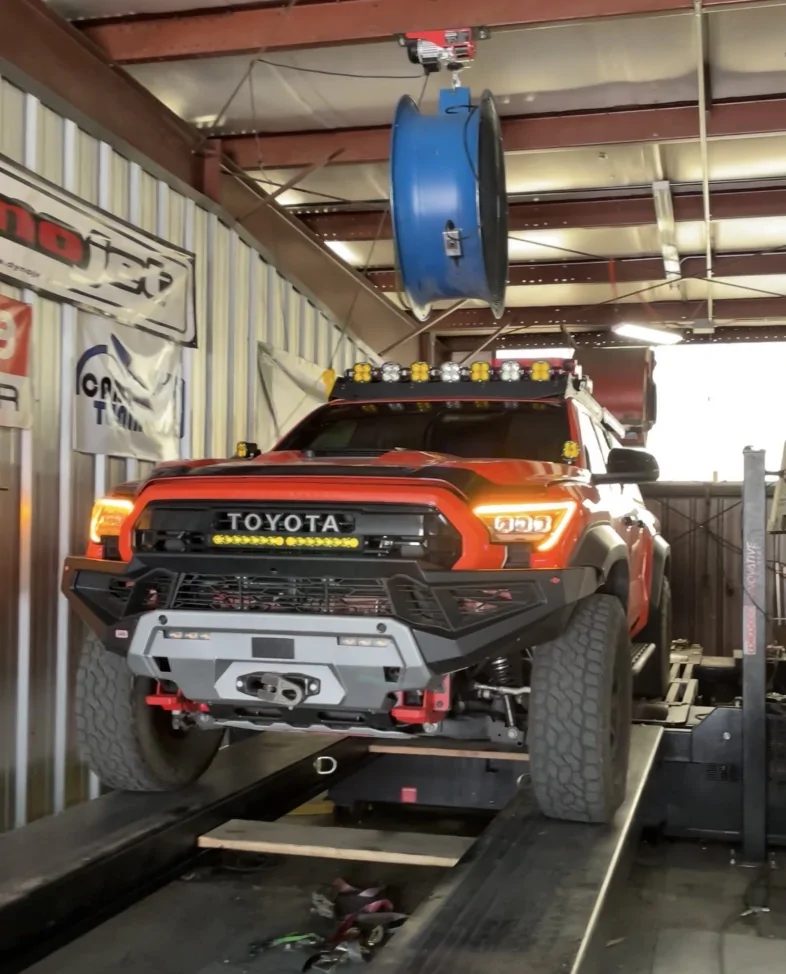
Test Vehicle
  • 2024 Toyota Tacoma (Non-Hybrid)
  • 8-Speed Automatic Transmission
  • Approximately 12,000 miles
  • 91 octane fuel
  • Dyno testing performed in 4th gear
  • AFE charge pipes installed throughout all testing
2024 Tacoma Intake Power Gain Comparison (Factory, Banks, SXTH, K&N) — Same Truck, Day, Dyno, Surprising Results 80321B95-EC3C-452D-B8B6-8685FFC12151


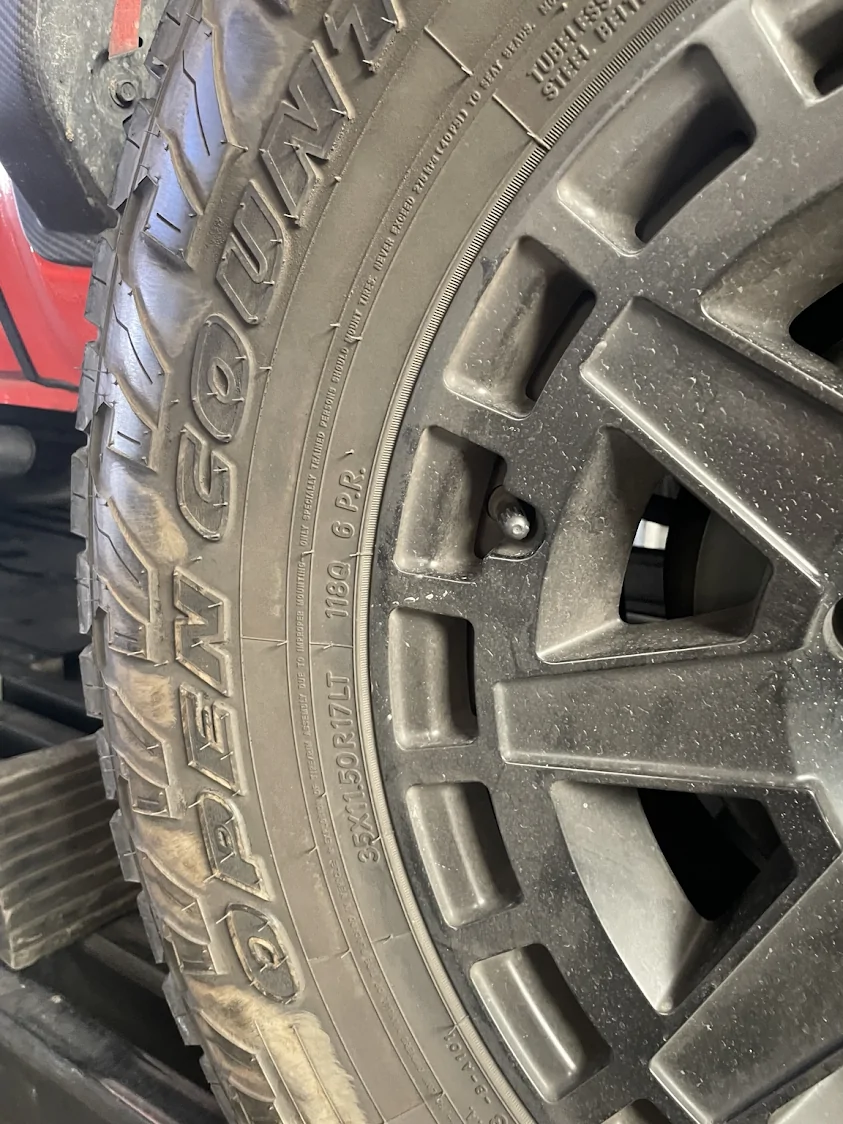
Wheel & Tire Setup
  • ICON alloy wheels
  • Toyo Open Country A/T tires
  • 35x11.50R17LT
  • Load Range C
2024 Tacoma Intake Power Gain Comparison (Factory, Banks, SXTH, K&N) — Same Truck, Day, Dyno, Surprising Results tir


It is important to note that this truck is running a significantly heavier-than-stock wheel and tire package. This absolutely affects measured wheel horsepower and acceleration rate on a chassis dyno compared to stock-equipped trucks.

The objective of this testing was comparative consistency between intake systems — not chasing the highest absolute dyno number.


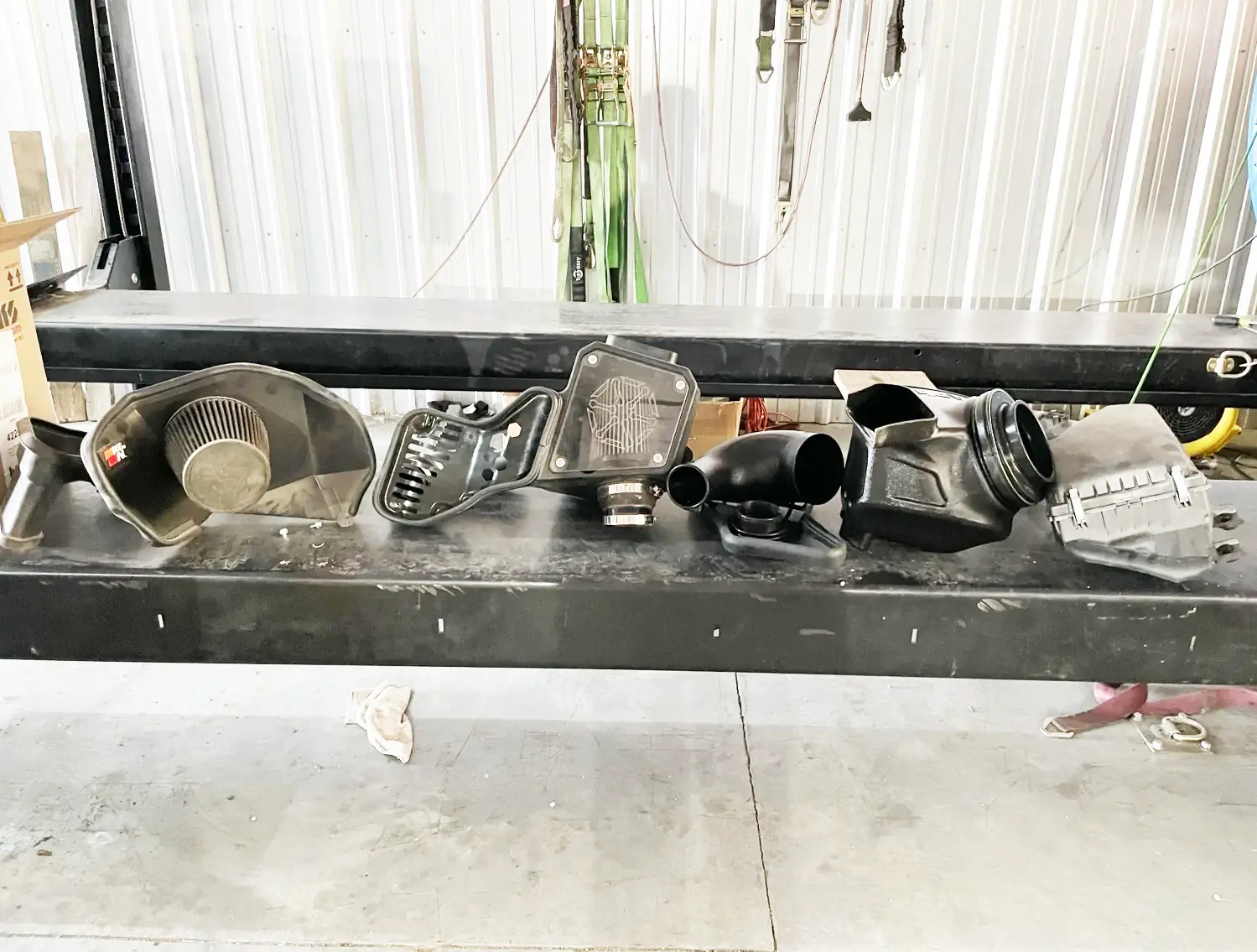
Intakes Tested
  • Factory airbox
  • Banks intake
  • SXTH intake
  • K&N intake (older version that does not replace the turbo inlet)
All intake comparisons shown below were performed on the factory calibration and stock turbocharger.


2024 Tacoma Intake Power Gain Comparison (Factory, Banks, SXTH, K&N) — Same Truck, Day, Dyno, Surprising Results 47078-5a1100fbff3c1a630cf2549d531eef5d


Test Procedure

Each intake was installed individually and tested using the same vehicle under the same conditions.

The following process was repeated for every intake:

  1. ECU learning reset performed
  2. Vehicle driven to begin repopulating learned airflow and fuel trim behavior
  3. Three dyno pulls performed
  4. Pull 0 was discarded because it was consistently lower immediately after the reset process began
  5. Pull 2 was used as the stabilized comparison run
One thing that surprised me during testing was how quickly this platform adapts after an ECU learning reset. The difference between Pull 1 and Pull 2 was smaller than expected across all intake systems, indicating that long term fuel trims and airflow model corrections populate very rapidly on this platform.


Dyno Results – Stock Calibration

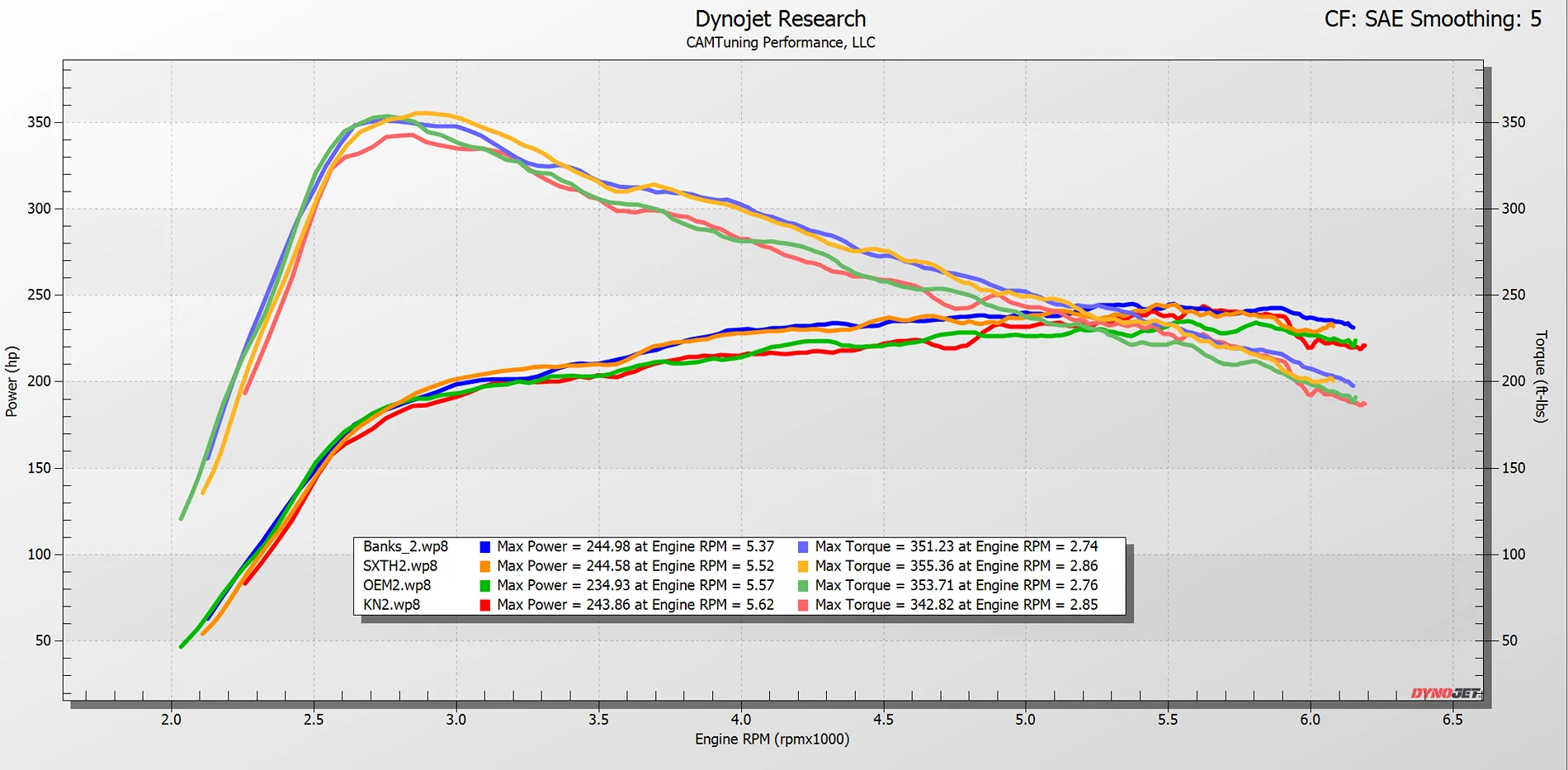
Despite significant differences in intake design, the dyno results were remarkably close.

Peak horsepower results:
  • Banks: 244.98 whp
  • SXTH: 244.58 whp
  • OEM Airbox: 234.93 whp
  • K&N: 243.86 whp
Torque curves were also extremely similar throughout most of the pull.

The biggest takeaway from the dyno portion of this testing is that on the factory calibration and stock turbocharger, the ECU’s torque and airflow management strategy minimizes outright power differences between quality intake systems more than many enthusiasts expect.


2024 Tacoma Intake Power Gain Comparison (Factory, Banks, SXTH, K&N) — Same Truck, Day, Dyno, Surprising Results intake dyno compliation


Fuel Trim Observations

While horsepower differences remained relatively small, fuel correction behavior varied much more noticeably between intake systems.

Approximate overall fuel trim behavior observed during testing:
  • OEM airbox: approximately ±5%
  • K&N: approximately ±5%
  • SXTH: approximately 10–12%
  • Banks: approximately 13–14%
This was in line with what I've seen on the other trucks I've tuned with tese intakes.
This does NOT necessarily mean one intake is “bad” and another is “good.” What it does show is that different intake geometries and MAF housing designs deviate from the factory airflow model by different amounts when operated on the stock calibration.

The factory ECU adapted quickly to all tested systems, but some required substantially more correction than others to maintain commanded fueling. None of them had any CEL during testing.


Final Thoughts

The most important aspect of this testing was consistency.

Every intake was tested:

  • on the same vehicle
  • on the same dyno
  • on the same fuel
  • on the same day
  • using the same testing procedure
That consistency matters far more than comparing isolated dyno numbers from different vehicles, climates, dynos, or adaptation states.

Under those controlled conditions, all tested intake systems performed relatively similarly on the factory calibration and stock turbocharger.

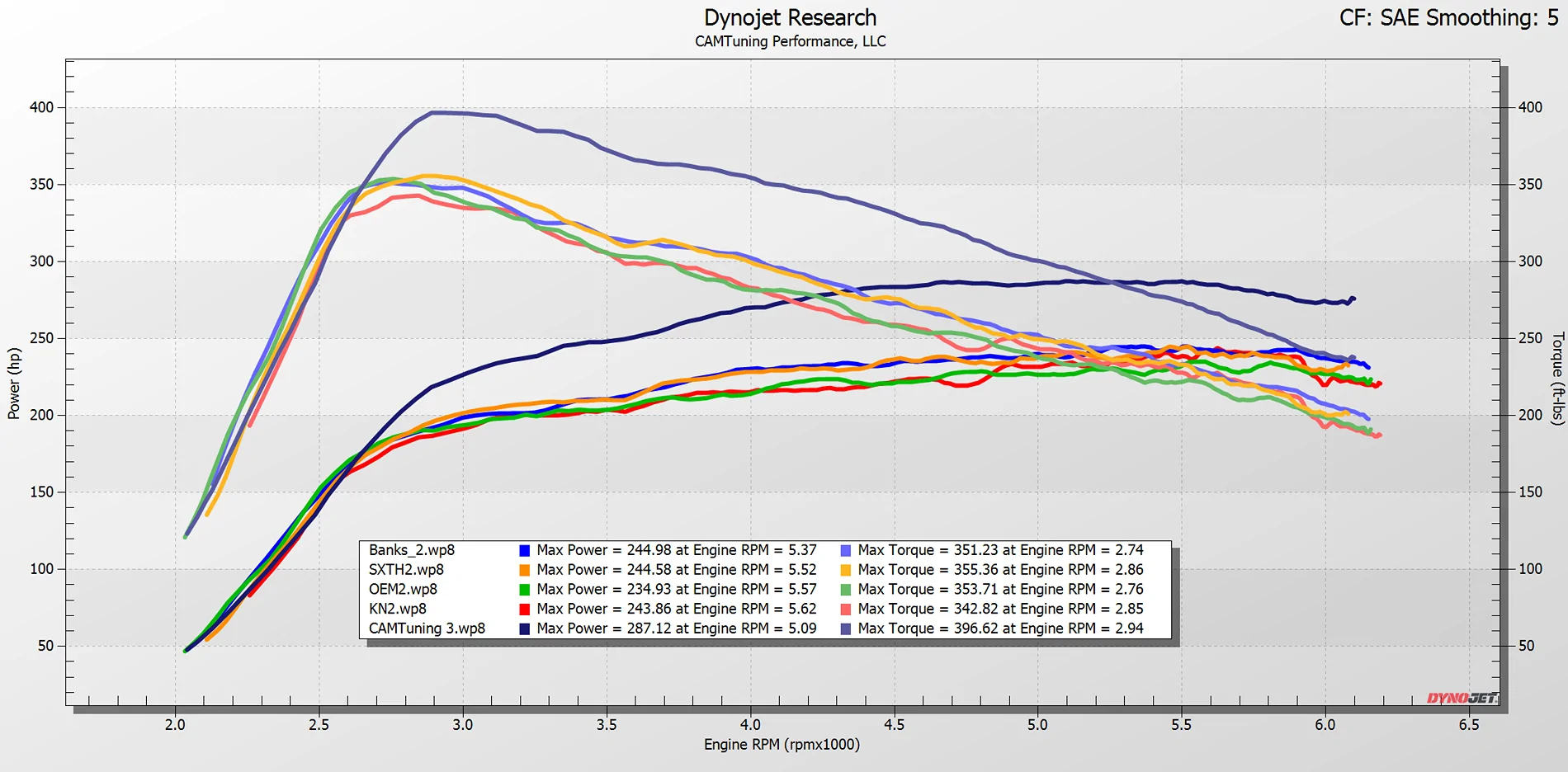
After completing the stock calibration testing, the K&N intake was professionally calibrated on 91 octane for the owner of this truck. Once the truck received a complete calibration — including airflow modeling, torque request strategy, fueling, ignition timing, boost control, and transmission tuning — the intake responded significantly better than it did on the factory calibration while maintaining stable fuel correction behavior.

2024 Tacoma Intake Power Gain Comparison (Factory, Banks, SXTH, K&N) — Same Truck, Day, Dyno, Surprising Results custom tune kn


That is the biggest conclusion from this testing:

These intake systems are all relatively comparable on the stock tune, but they have substantially more potential once paired with proper professional calibration.

The factory ECU is capable of adapting surprisingly well on its own, but custom tuning allows the airflow model, fuel correction behavior, and overall performance to be optimized correctly rather than simply compensated for.
Sponsored


AmbyBomb

TRD Sport
Well-known member
First Name
Nick
Joined
Jan 30, 2026
Threads
8
Messages
75
Reaction score
58
Location
Alberta, Canada
Vehicle(s)
2026 Tacoma TRD Sport
How much of a difference does just calibrating for the intake make, ie. what is the difference between an off the shelf tune with an intake and a custom tune with an intake?
 

laidouttaco

SR5
Member
First Name
Brandon
Joined
Feb 19, 2026
Threads
1
Messages
6
Reaction score
7
Location
california
Vehicle(s)
2025 Tacoma sr5
2024 Tacoma Intake Comparison Testing – Stock Calibration vs Real-World Results

After much online discussion about intake performance on the new 2.4T Tacoma platform, I wanted to perform a controlled comparison between several popular intake systems using the same truck, same dyno, same fuel, and same testing procedure.

The goal was not to prove that one intake “wins,” but rather to document how these systems behave on the factory calibration and how the ECU responds to them under controlled conditions.


This testing was intended to provide comparative real-world data using a consistent and repeatable process. While no chassis dyno comparison can perfectly eliminate every variable, significant effort was made to keep testing conditions as consistent as possible between intake systems, including vehicle configuration, fuel, dyno setup, operating temperature, adaptation process, and test procedure.

The results shown here should be viewed as comparative findings from this specific vehicle and test environment, not as absolute universal performance numbers for every truck or condition.


Test Vehicle
  • 2024 Toyota Tacoma (Non-Hybrid)
  • 8-Speed Automatic Transmission
  • Approximately 12,000 miles
  • 91 octane fuel
  • Dyno testing performed in 4th gear
  • AFE charge pipes installed throughout all testing
80321B95-EC3C-452D-B8B6-8685FFC12151.webp


Wheel & Tire Setup
  • ICON alloy wheels
  • Toyo Open Country A/T tires
  • 35x11.50R17LT
  • Load Range C
tire.webp


It is important to note that this truck is running a significantly heavier-than-stock wheel and tire package. This absolutely affects measured wheel horsepower and acceleration rate on a chassis dyno compared to stock-equipped trucks.

The objective of this testing was comparative consistency between intake systems — not chasing the highest absolute dyno number.


Intakes Tested
  • Factory airbox
  • Banks intake
  • SXTH intake
  • K&N intake (older version that does not replace the turbo inlet)
All intake comparisons shown below were performed on the factory calibration and stock turbocharger.


47078-5a1100fbff3c1a630cf2549d531eef5d.webp


Test Procedure

Each intake was installed individually and tested using the same vehicle under the same conditions.

The following process was repeated for every intake:

  1. ECU learning reset performed
  2. Vehicle driven to begin repopulating learned airflow and fuel trim behavior
  3. Three dyno pulls performed
  4. Pull 0 was discarded because it was consistently lower immediately after the reset process began
  5. Pull 2 was used as the stabilized comparison run
One thing that surprised me during testing was how quickly this platform adapts after an ECU learning reset. The difference between Pull 1 and Pull 2 was smaller than expected across all intake systems, indicating that long term fuel trims and airflow model corrections populate very rapidly on this platform.


Dyno Results – Stock Calibration

Despite significant differences in intake design, the dyno results were remarkably close.

Peak horsepower results:
  • Banks: 244.98 whp
  • SXTH: 244.58 whp
  • OEM Airbox: 234.93 whp
  • K&N: 243.86 whp
Torque curves were also extremely similar throughout most of the pull.

The biggest takeaway from the dyno portion of this testing is that on the factory calibration and stock turbocharger, the ECU’s torque and airflow management strategy minimizes outright power differences between quality intake systems more than many enthusiasts expect.

intake dyno compliation.webp


Fuel Trim Observations

While horsepower differences remained relatively small, fuel correction behavior varied much more noticeably between intake systems.

Approximate overall fuel trim behavior observed during testing:
  • OEM airbox: approximately ±5%
  • K&N: approximately ±5%
  • SXTH: approximately 10–12%
  • Banks: approximately 13–14%
This was in line with what I've seen on the other trucks I've tuned with tese intakes.
This does NOT necessarily mean one intake is “bad” and another is “good.” What it does show is that different intake geometries and MAF housing designs deviate from the factory airflow model by different amounts when operated on the stock calibration.

The factory ECU adapted quickly to all tested systems, but some required substantially more correction than others to maintain commanded fueling. None of them had any CEL during testing.


Final Thoughts

The most important aspect of this testing was consistency.

Every intake was tested:

  • on the same vehicle
  • on the same dyno
  • on the same fuel
  • on the same day
  • using the same testing procedure
That consistency matters far more than comparing isolated dyno numbers from different vehicles, climates, dynos, or adaptation states.

Under those controlled conditions, all tested intake systems performed relatively similarly on the factory calibration and stock turbocharger.

After completing the stock calibration testing, the K&N intake was professionally calibrated on 91 octane for the owner of this truck. Once the truck received a complete calibration — including airflow modeling, torque request strategy, fueling, ignition timing, boost control, and transmission tuning — the intake responded significantly better than it did on the factory calibration while maintaining stable fuel correction behavior.
custom tune kn.webp


That is the biggest conclusion from this testing:

These intake systems are all relatively comparable on the stock tune, but they have substantially more potential once paired with proper professional calibration.

The factory ECU is capable of adapting surprisingly well on its own, but custom tuning allows the airflow model, fuel correction behavior, and overall performance to be optimized correctly rather than simply compensated for.
Amazing work Cam! What the people needed and you made it happen! This will definitely help everyone understand and decide which intake to get for their truck!
 
OP
OP
CAMTuning

CAMTuning

TRD Off-Road
Well-known member
BASIC Sponsor
First Name
Cameron
Joined
Apr 2, 2025
Threads
18
Messages
262
Reaction score
356
Location
New Mexico
Vehicle(s)
2025 Tacoma TRD OffRoad
How much of a difference does just calibrating for the intake make, ie. what is the difference between an off the shelf tune with an intake and a custom tune with an intake?
Off the shelf as in Cobb off the shelf? Or stock? Scaling the intake to correct the fuel trims will not make a big difference in final fueling but can affect calculated load, which is the y axis on the timing tables. If fuel trims are high, calculated load is slightly low, which could result in a very minor increase in spark advance.​
 

AmbyBomb

TRD Sport
Well-known member
First Name
Nick
Joined
Jan 30, 2026
Threads
8
Messages
75
Reaction score
58
Location
Alberta, Canada
Vehicle(s)
2026 Tacoma TRD Sport
Off the shelf as in Cobb off the shelf? Or stock? Scaling the intake to correct the fuel trims will not make a big difference in final fueling but can affect calculated load, which is the y axis on the timing tables. If fuel trims are high, calculated load is slightly low, which could result in a very minor increase in spark advance.​
Cobb or other tune.
 

Sponsored

OP
OP
CAMTuning

CAMTuning

TRD Off-Road
Well-known member
BASIC Sponsor
First Name
Cameron
Joined
Apr 2, 2025
Threads
18
Messages
262
Reaction score
356
Location
New Mexico
Vehicle(s)
2025 Tacoma TRD OffRoad
Cobb or other tune.
Using a map that was otherwise stock but has the MAF scaling corrected would make the fuel trims smaller, but would not net more power than not tuning (the tuner in me would be happier that the fuel trims were dialed though).
Using a Cobb map would make similar power (but of course more than stock) with the MAF scaled vs left alone.
There are exceptions here:
The TRD Pro intake has a larger MAF housing, and will run a non Pro lean if installed and no tuning is done.
A non -Pro intake on a Pro or TH will run very rich, to the point of stumbling if not calibrated.
These have been well documented by others.

Notably, the Stillen intake, at least earlier versions (I'm not sure if they have revised it) runs lean enough to cause a CEL on many trucks. I just tuned one a few weeks ago and the long term fuel trims were ~23%, which is unacceptable, and was resulting in a check engine light.
 

co425

TRD Off-Road
Well-known member
First Name
Brandon
Joined
May 27, 2025
Threads
2
Messages
65
Reaction score
41
Location
California
Vehicle(s)
BMW Motorcycle
Just based off the charts it looks to me like buying an intake for the average driver is pointless. Most of us wouldn’t be spending our day to day driving at 3500 plus rpm.

I was heavily considering a Banks intake but looking at the dyno charts makes me feel my money would be better spent elsewhere.

Thank you for putting in the hard work for this.
 

Naznac

TRD Off-Road
Member
Joined
Nov 20, 2025
Threads
0
Messages
12
Reaction score
10
Location
Canada
Vehicle(s)
Tacoma 2025 Off-road
There's one thing I've always wondered about the Dyno tests. since they are "stationary" tests it doesn't take into account the effects of a larger ram scoop at highway speed. What would be the expected difference considering that parameter?
 

JayTech

TRD Off-Road Premium
Well-known member
First Name
Jay
Joined
May 5, 2025
Threads
2
Messages
193
Reaction score
195
Location
Canada
Vehicle(s)
2025 Toyota Tacoma TRD ORP
There's one thing I've always wondered about the Dyno tests. since they are "stationary" tests it doesn't take into account the effects of a larger ram scoop at highway speed. What would be the expected difference considering that parameter?
They typically have fans blowing air across the front during dyno runs to simulate airflow but for a way of measuring power that is probably as accurate and close as you can get. I don't know if there really is a calculation that can account for that as there are too many variables(wind speed, temperature, turbo/intercooler heat soak etc).
 

Sponsored

Cabby30

TRD Off-Road Premium
Well-known member
Joined
Jun 4, 2024
Threads
9
Messages
143
Reaction score
149
Location
CA
Vehicle(s)
2024 DCLB TRD OR
Just based off the charts it looks to me like buying an intake for the average driver is pointless. Most of us wouldn’t be spending our day to day driving at 3500 plus rpm.

I was heavily considering a Banks intake but looking at the dyno charts makes me feel my money would be better spent elsewhere.

Thank you for putting in the hard work for this.
You're looking at around 10hp increase with any of the intakes and negligible torque. I will speak for myself when I say the main reason I purchased an intake was for increased induction sound. If you get a tune + an intake (which I have) that's when you'll see more of the benefits of the intake (over stock box), since the stock calibration is the limiting factor.

That is my anecdotal input on this, including what I've learned in this thread. Thanks for sharing Camtuning!
 

Sagebrush

TRD Off-Road Premium
Well-known member
First Name
Tony
Joined
May 18, 2024
Threads
15
Messages
1,311
Reaction score
1,331
Location
Salmon Idaho
Vehicle(s)
2024 Tacoma OR with Premium package
Aren’t you supposed to drive hard here and their to burn off all the carbon build up though?
I run Valvoline Restore and Protect motor oil, and it's proven to remove carbon buildup in the rings and engine block–including sludge and varnish.

Carbon doesn't magically go away until it reaches above 600º F. Since the exhaust valves run hotter than that, they shouldn't get carbon buildup. The intake valves are continuously washed with fuel, which is a damn good reason to run top-tier gas to prevent carbon there.

Thus, I'm not going to make my engine healthier by tromping on the accelerator.
 
Last edited:

redlimitediforcemax

Limited
Well-known member
Joined
May 2, 2025
Threads
1
Messages
48
Reaction score
42
Location
Oregon
Vehicle(s)
2024 Tacoma Limited I-force Max
This is freaken awesome. Thank you for the scientific approach on this. More importantly unbiased and backed by awesome data. Great job Cam!
 

gmalkmus

TRD Off-Road
Well-known member
Joined
Nov 17, 2025
Threads
2
Messages
46
Reaction score
56
Location
SW Missouri
Vehicle(s)
2025 Tacoma TRD Offroad 6MT, 2015 Mustang GT 6MT
Well dang! The gap between the SXTH and the Banks is way closer than I figured it would be. Interesting that the SXTH actually has better fuel trims too.

I 100% fell for the Banks marketing koolaid and sold my SXTH to get the Banks. Now I wish I would have just kept the SXTH because it sounded soooo much better. Definitely worth the 0.4 horsepower less versus the Banks lol.
Sponsored


Top